 CHAT & ASK AI
 AI Search Engine
 AI Image Generator
 AI Youtube Analyzer
 Whatsapp Integration
Stable Diffusion: Model Overview, Variants, and Core Capabilities
Stable Diffusion is a diffusion-based generative model developed on large-scale training systems to produce images, short video sequences, and other creative outputs within open-source image generation ecosystems. At a conceptual level, the model learns to reverse a noising process: starting from random noise and iteratively denoising toward a target image conditioned on textual prompts or other inputs. Its architecture separates a compact latent representation from a high-resolution decoder, which makes generation more efficient and adaptable for creative and technical workflows across research, design, and hobbyist use.
Try for Free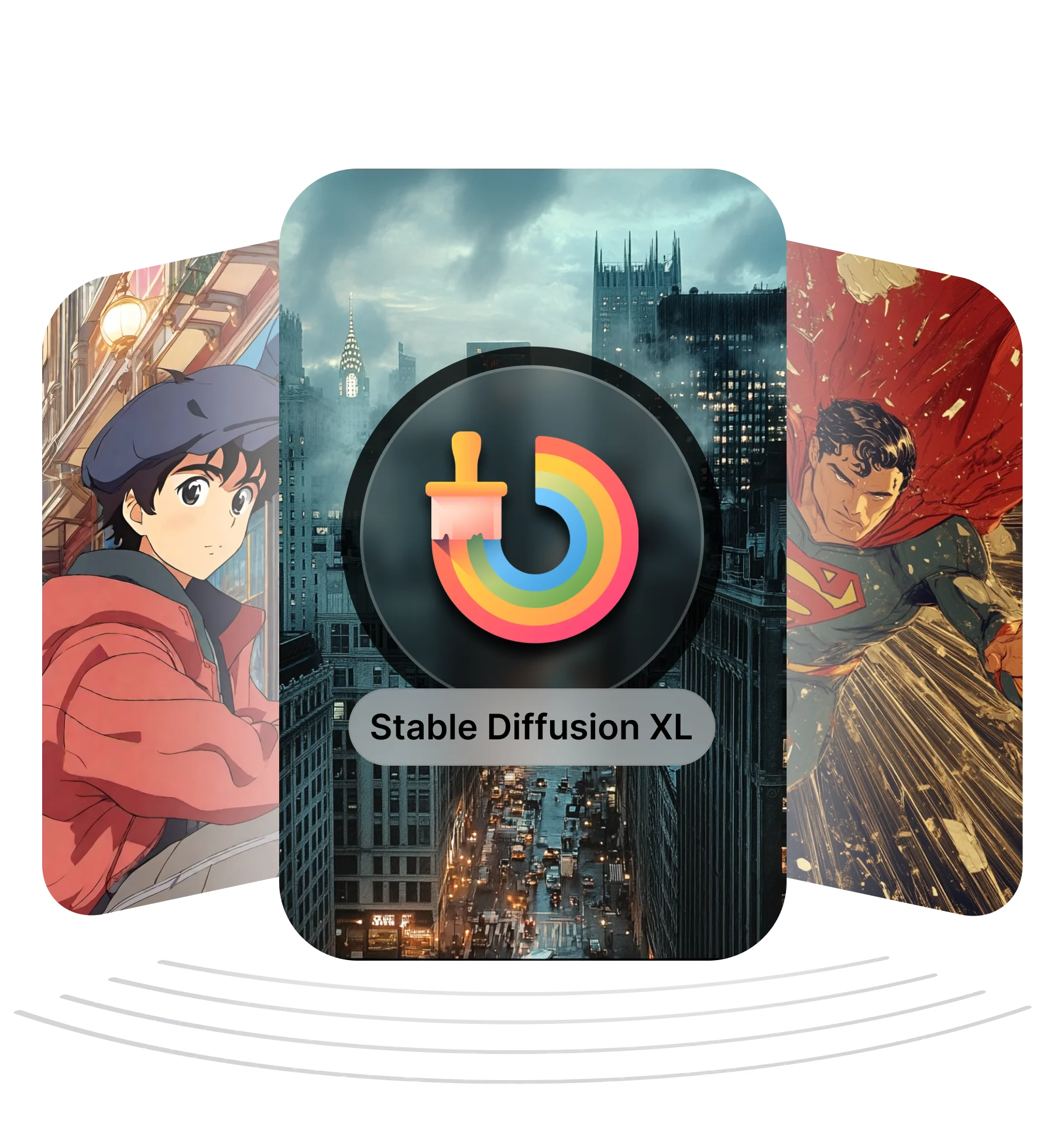
What Is Stable Diffusion? Core Design and Model Variants
Stable Diffusion refers to a family of latent diffusion architectures built on advanced generative designs. These models use an encoder to map images into a lower-dimensional latent space, a diffusion model to perform denoising steps in that latent space, and a decoder to reconstruct images at pixel resolution. Major releases include models built on Stable Diffusion XL and models powered by Stable Diffusion 3, which vary by training dataset scale, architecture refinements, and decoder detail. Different variants target distinct goals: higher fidelity and complex scene rendering, faster inference with smaller footprints, or specialized checkpoints tuned for particular visual styles. The ecosystem also supports community checkpoints and fine-tuned weights for tasks such as inpainting, image-to-image translation, and style transfer.
How the Diffusion Process Works
The diffusion mechanism begins by adding controlled Gaussian noise to training images across many steps, teaching the model to predict the removed noise at each stage. During generation, the model starts from a noise sample and applies the learned denoising function iteratively, guided by a conditioning signal (for example, a text prompt embedded via a text encoder). Working in latent space reduces computational load: the denoising model operates on compact representations, and a decoder later converts the cleaned latent back into a full-resolution image. Samplers (such as DDIM or ancestral samplers) and scheduler choices determine step schedules and can trade off speed versus fine detail.
Practical Capabilities and Creative Applications
These generative models can create single images, series of frames for video experiments, variations of existing images, and prompt-driven compositions. Typical creative uses include digital art generation, concept visuals for design and entertainment, rapid prototyping of visual ideas, stylized portraits, and asset mockups. Models built on Stable Diffusion XL tend to focus on rendering complex compositions and finer details, while models powered by Stable Diffusion 3 reflect improvements introduced during subsequent training cycles. The open-source nature enables integration into web tools, local pipelines, and batch production flows.
Prompt Construction and Output Behavior
Prompt structure strongly affects style, composition, and detail. Clear prompts often combine concise subject descriptions, style cues (artist or medium), and compositional notes (lighting, camera angle, focal length). Negative prompts instruct the model to avoid unwanted elements. Model parameters—such as guidance scale, number of denoising steps, and sampler selection—change how closely the output follows the prompt and how much creativity or variance appears. Prompt libraries and preset templates can speed up consistent outputs for series work. Experimentation with shorter versus longer prompts, or with explicit constraints, helps refine results for specific tasks like an stable diffusion ai image generator use case or a stable diffusion tattoo with text application.
Limitations, Safety Notes, and Responsible Use
Generative systems may produce artifacts, incorrect text rendering, or unintended content if prompts are ambiguous. Image quality and generation speed depend on available hardware and model size; large models require more memory and GPU processing. Responsible use includes respecting copyright and privacy, avoiding prompts that request real-person likenesses without consent, and adhering to licensing terms for model weights and training data. Open-source releases often include usage guidelines and safety filters; practitioners should combine technical controls with human review in production contexts.
Frequently Asked Questions
What is Stable Diffusion?

How does the diffusion process generate images?
Is Stable Diffusion free to use?
What are the differences between major versions like SDXL or SD3?
How can Stable Diffusion be installed or run online?
