 CHAT & ASK AI
 AI Search Engine
 AI Image Generator
 AI Youtube Analyzer
 Whatsapp Integration
Chat & Ask AI: Developed on OpenAI Models
Ask AI, your access point to advanced AI solutions developed on OpenAI's most advanced models. The platform smoothly incorporates the technologies developed on GPT-5.2, GPT-5, GPT-4o, and GPT-o3 mini, bringing you unmatched abilities in text-based chats, problem-solving, and making creative content. Let's explore how these powerful AI technologies can change your daily tasks and work projects.
Try for Free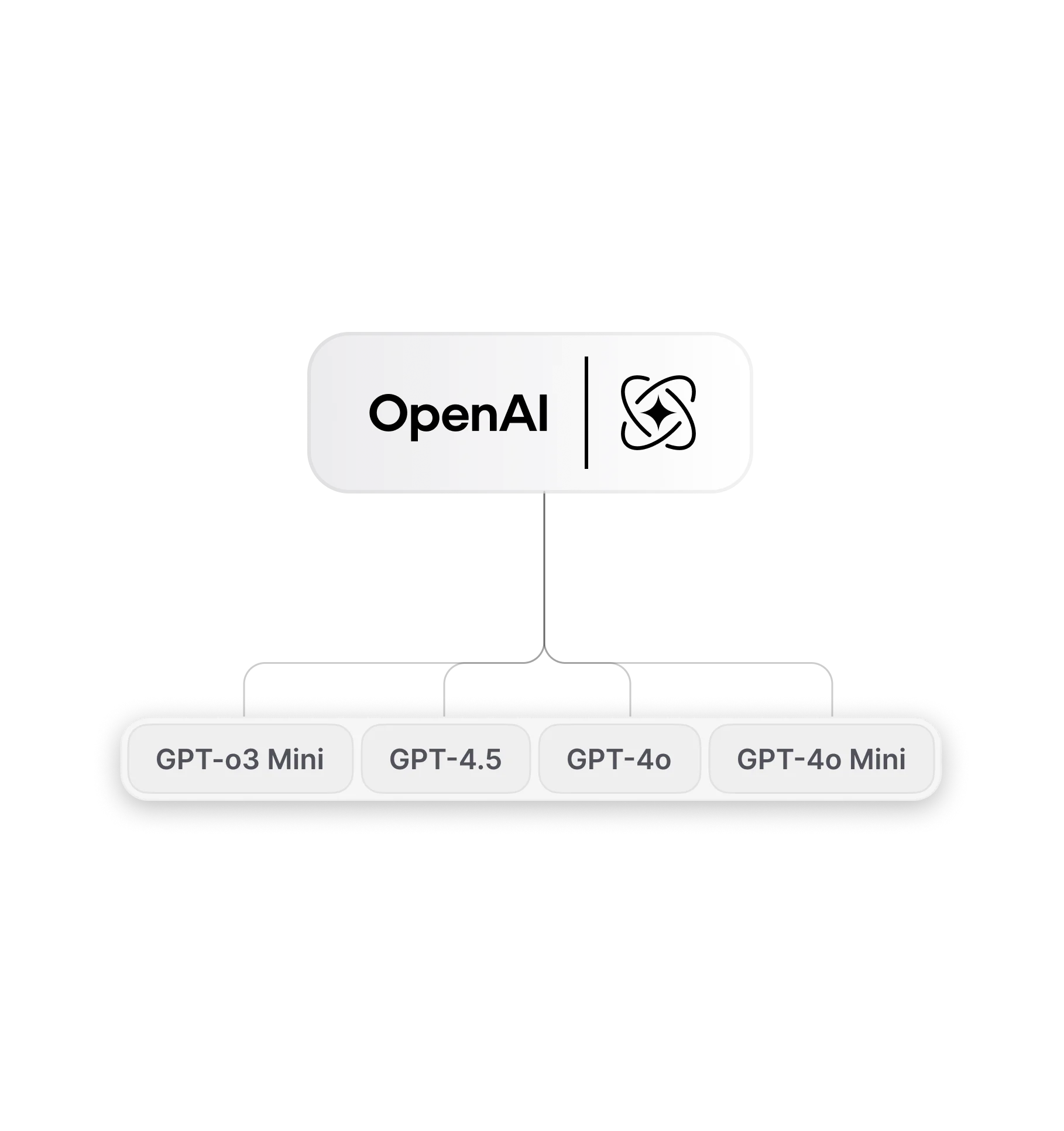
Advanced AI Models: Built on GPT-5.2 & GPT-5.1
The OpenAI family inside Chat & Ask AI consists of large architectures developed on advanced training infrastructure. Deployments include variants powered by GPT-5.2, powered by GPT-5.1, developed on OpenAI o3, built on GPT-4o, powered by GPT-4o-mini, and built on GPT-4.1. Each variant targets specific technical needs: some focus on high-precision reasoning and long-context processing, others handle multimodal inputs such as images plus text, and certain versions prioritise low-latency, cost-effective interaction for high-volume queries. Selection and runtime parameters are set to match task profiles while keeping consistent input/output conventions.
Model Roles and Technical Positioning
Reasoning-heavy workflows route to models built for extended context and step-based analysis.
Creative and generative tasks use models developed to handle expressive text and multimodal prompts.
Coding and debugging requests progress to models powered by focused code-understanding capabilities.
Fast conversational exchanges are handled by models powered for rapid-response operation.
Capabilities and Input Handling
Models accept plain text prompts, uploaded documents, code snippets, and images. Long-context inputs use segmented context windows and summarization strategies to preserve continuity. Multimodal inputs combine visual and textual data into unified representations, enabling captions, analyses, or integrated outputs. API-style usage supports structured prompts, system instructions, and return formats suitable for downstream processing or human review.
Key Capabilities Across the Model Lineup
Core abilities common to the OpenAI family include structured reasoning for multi-step problems, code generation and interpretation, multilingual output, and multimodal comprehension. Performance attributes arise from model architecture, training data scope, and task-specific fine-tuning. Implementations provide reproducible outputs, configurable temperature and length controls, and support for common developer and content workflows.
Reasoning, Coding, and Complex Task Handling
Models break complex tasks into discrete steps, apply internal chains of reasoning, and can include intermediate explanations. For code queries, models produce example snippets, inline comments, and refactoring suggestions. Analytical requests may return tabular summaries, calculated results, or structured plans for review and iteration.
Multimodal and Long-Context Abilities
Multimodal capabilities let models interpret images alongside text, extract key details, and merge those signals into coherent responses. Long-context handling relies on hierarchical summarization and sliding-window context methods to keep relevance across extended documents or multi-turn conversations, supporting tasks such as document summarization and extended debugging sessions.
Using OpenAI Models Inside Chat & Ask AI
Within the Chat & Ask AI interface, model selection and task setup follow a consistent flow. A model choice can be specified before submission, or the system can suggest a suitable variant based on task type. Inputs may be typed, pasted, or uploaded. Outputs return as readable text, code blocks, or media assets depending on the request and model capability.
Interaction Flow and Supported Input Types
Text prompts: natural-language questions, instructions, or structured prompts.
Documents: PDFs, Word files, and other text documents for summarization or extraction.
Code: snippets for review, testing, or generation.
Images: uploaded visuals for captioning, analysis, or context-aware responses.
Chained interactions are supported so model outputs can feed subsequent prompts for refinement.
Availability, Stability, and Access Notes
Model availability follows platform status and access policies. Throughput and response stability can vary with system load and selected variant. Status indicators show maintenance windows or transient interruptions. Access controls and authentication determine who may select advanced variants; error handling and retry guidance support interrupted operations.
Advancements Toward the GPT-6 Generation
Recent development cycles across systems built on GPT-5.4 and powered by GPT-5.3 Codex reflect a continued transition toward memory-aware interaction models and extended workflow persistence. Earlier advancements introduced through architectures built on GPT-4o and powered by GPT-4o mini established stronger multimodal processing and long-context handling, forming the technical foundation for upcoming generations. Within this progression, future systems aligned with architectures expected beyond GPT-5 are widely associated with expanded context continuity, adaptive reasoning depth, and unified execution across coding, browsing, and structured analysis workflows. Infrastructure scaling efforts and training pipeline expansion observed across environments developed on next-generation compute frameworks indicate that systems associated with the upcoming GPT-6 generation are expected to place stronger emphasis on persistent interaction memory, extended session continuity, and coordinated multi-step execution across tasks. These developments suggest that architectures aligned with GPT-6 may represent a shift toward workflow-oriented operation models capable of maintaining structured context over longer interaction cycles, supporting more adaptive and sustained task handling across diverse technical and creative workflows.
Frequently Asked Questions
What are the OpenAI models available inside Chat & Ask AI?

How do these models handle text, images, or other multimodal inputs?
Do OpenAI models on Chat & Ask AI have usage limits or context constraints?
How can users access or switch between different OpenAI models?
Are OpenAI models suitable for tasks like coding, analysis, and content generation?
Is there a free way to use OpenAI models inside Chat & Ask AI?
How does pricing work for OpenAI models when used through the platform?
What should users do if an OpenAI model appears unavailable or unresponsive?
How do the models handle safety, accuracy, and reliable output generation?
Can OpenAI models be used for image creation or other creative tasks?
What types of projects benefit most from the OpenAI models available on Chat & Ask AI?
