
 AI検索エンジン
 AI画像生成
 AI YouTube解析
 WhatsApp連携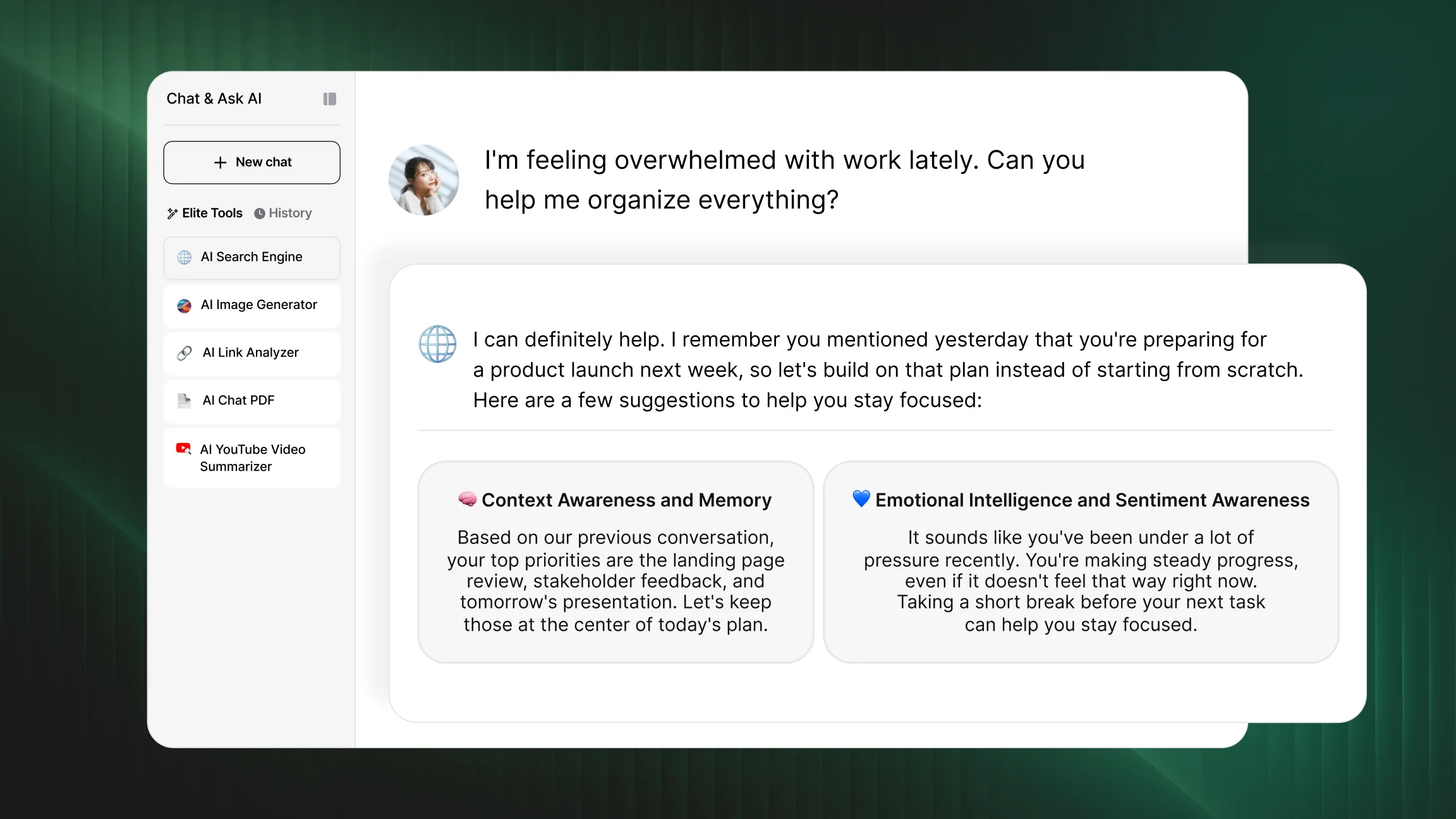
What Makes an AI Chatbot Smart?
A smart AI chatbot can understand natural language, recognize what a user is actually asking for, keep track of context across a conversation, and generate relevant responses instead of relying only on fixed scripts. These abilities separate an intelligent AI chatbot from a basic, rule-based one, and they are the foundation for almost every other feature discussed on this page.
A simple chatbot typically depends on predefined flows and exact keyword matches. When a question falls outside its scripted paths, it struggles or gives an unrelated answer. A smart AI chatbot, on the other hand, can handle varied phrasing, incomplete questions, follow-up prompts, and shifts in conversation direction. It can also connect one message to the next, so a user does not need to restate context that was already given earlier in the conversation. This is the core difference between a conversational AI chatbot and an older, rule-based system: one interprets meaning, while the other matches patterns against a fixed script.
Natural Language Understanding: How Smart Chatbots Understand Intent?
Natural Language Understanding, or NLU, allows an AI chatbot to identify what a user means, even when the message is phrased informally or worded differently than expected. Instead of matching exact keywords, NLU interprets meaning, context, and phrasing together, which is what allows a chatbot to respond correctly even when a request is written imprecisely.
For example, a user might ask the same question in several different ways, such as requesting a summary, asking for a shorter version, or asking what a document says overall. A capable chatbot recognizes that these all point to the same underlying request, rather than treating each phrasing as a separate task. NLU also helps a chatbot respond usefully even when a question is vague, incomplete, or missing key details, since the system can infer likely intent from the surrounding conversation. This is one of the features most commonly highlighted when comparing intelligent chatbot systems, because weak language understanding tends to surface quickly through repeated misunderstandings or irrelevant answers.
Context Awareness and Memory in AI Chatbot Conversations
Context awareness allows an AI chatbot to remember earlier parts of the same conversation instead of treating every new message as an isolated request. This is what makes multi-step tasks and follow-up questions possible without repeating information each time, and it is one of the clearest signs of a genuinely intelligent system rather than a scripted one.
Memory improves how a chatbot handles document analysis, where a user might upload a contract or research paper through AI chat for PDF and then ask several follow-up questions about the same file, with the chatbot maintaining awareness of the document throughout. Memory also supports writing assistance, research workflows, and general personal assistance, where continuity across messages matters more than any single reply on its own.
At the same time, an AI chatbot with memory should be handled carefully. Users are generally advised to think about what information should be shared with an AI chatbot, particularly around sensitive personal or financial details, since a personalized AI chatbot experience still depends entirely on how much a user chooses to disclose and how that information is stored.
Generative AI and Response Quality
Generative AI allows a chatbot to create original, context-based responses rather than selecting from a fixed set of pre-written answers. This is what makes an AI chatbot's replies feel specific to the question asked, rather than generic or templated, and it is the mechanism behind most of what people describe as "smart" in a chatbot's behavior.
Large language models help chatbots summarize long material, explain complex topics, translate text, brainstorm ideas, and answer layered questions with several parts. Platforms built on advanced models can support a range of workflows, including everyday writing tasks handled through an AI writer, research summaries, and document review, since generative capability is what allows a chatbot to adapt its output to the specific request rather than repeating fixed templates regardless of context. The quality of these responses also depends on how well earlier context has been retained, which is why generative ability and memory tend to work closely together in practice.
Emotional Intelligence and Sentiment Awareness
Emotional intelligence in an AI chatbot refers to its ability to recognize tone, urgency, or frustration within a message and adjust its response accordingly. This does not mean the system experiences emotion. It means the underlying model can detect signals in language, such as short or frustrated phrasing, and respond with an appropriate tone or escalate a conversation when needed.
Sentiment analysis supports this behavior by identifying patterns associated with dissatisfaction or urgency within a message. Combined with tone adjustment and escalation logic, this contributes to a smoother user experience, particularly in support-related conversations where recognizing frustration early can prevent a poor interaction from continuing unnoticed. This feature is generally treated as one ingredient among several rather than a standalone measure of intelligence, since a chatbot can read tone accurately and still fail at other core tasks.
Domain Knowledge and Useful Task Completion
A chatbot becomes more useful when it understands the subject or task it is helping with, not only the individual words in a message. Domain knowledge shows up in academic help, writing support, technical documentation, customer support, and research tasks where accuracy depends on understanding context specific to that field rather than general language patterns alone.
This is also relevant for business use cases, such as drafting promotional copy through a marketing assistant, where understanding the purpose behind a request affects how useful the output actually is. A chatbot with strong domain awareness can distinguish between a request for a formal business proposal and a casual social post, adjusting structure and tone accordingly. This kind of contextual judgment is what separates a chatbot that produces technically correct text from one that produces genuinely usable output for a specific task.
Integrations, Tools and Real Workflow Support
Smart AI chatbots become more practical when they connect conversation with tools that extend what they can do. Intelligence in a chatbot is not only about conversation quality. It is also about helping a user complete an actual task from start to finish, which is where integrations and connected tools come into play.
This includes running a current search through AI web search for up to date information that a language model alone would not have access to, checking the content behind a shared link before reading it in full, or getting a condensed overview through a YouTube summarizer instead of watching an entire clip. Additional tools such as image generation extend a chatbot's usefulness even further, allowing a single conversation to move between text, research, and visual output as a task requires. Chat & Ask AI is one example of a platform that combines chat, document analysis, research tools, and creative generation within a single conversation, which reflects how integrations turn a chatbot from a text generator into a broader workflow assistant.
Limitations of AI Chatbots
Even a smart AI chatbot can misunderstand context, produce an incomplete answer, or require a user to verify important information before relying on it. These limitations are worth understanding alongside the benefits, since no chatbot, regardless of how advanced its underlying model is, performs with complete accuracy in every situation.
Hallucinations, where a chatbot generates plausible but inaccurate information, remain a known limitation across AI systems. Chatbots can also work from outdated information depending on their training data, and privacy concerns arise when sensitive data is shared in conversation without a clear understanding of how it is stored or used. Overreliance on chatbot output for professional, medical, legal, or emotionally sensitive judgment carries risk, since these systems do not replace human expertise in situations that genuinely require it. Understanding these boundaries helps users get more consistent value from a chatbot while knowing when a response needs additional verification.

