Perplexity vs Grok: Feature Comparison for AI Workflows

Perplexity vs Grok comes down to two distinct approaches to finding and delivering information. Perplexity focuses on sourced, structured research summaries, while Grok focuses on fast, conversational replies with real time data access. Both handle web search, but they behave differently across research, writing, and daily productivity workflows.

Date June 30, 2026 · Emily Harrison

Understanding the Differences Between Perplexity and Grok

Perplexity, powered by Perplexity AI's Sonar model family including Sonar, Sonar Pro, and Sonar Deep Research, is built around search-oriented workflows. It retrieves information from indexed web sources, surfaces explicit citations alongside answers, and structures output as sourced summaries rather than conversational replies. The Perplexity technology page covers how Sonar-based retrieval handles source attribution and structured information delivery across research tasks.

Grok, powered by xAI's Grok 4 series including the current Grok 4.3 release, is built around conversational interaction and live data access. It responds quickly, retains context across a thread, and pulls from the web and the X platform for near real-time information. The Grok technology page covers how the Grok 4 series handles live search, reasoning, and fast-turn interaction across dynamic topics.

Feature Area Perplexity (Sonar) Grok (Grok 4 / 4.3)
Primary Workflow Search oriented, query to sourced summary. Conversational, turn-based, reactive replies.
Typical Use Cases Research workflows, fact checking, knowledge discovery. Fact Finder Live topic exploration, chat-based assistance, fast Q&A.
Source Handling Explicit citations and referenced snippets. Citation Master Fewer inline citations; conversational references and summaries.
Real-time Data Can incorporate web search results and aggregated sources. Designed for fast updates and integration with frequently updated sources. Live X Search
Response Format Structured summaries, lists, and sourced passages. Shorter replies, follow-up prompts, and conversational threads.
Speed Focus on thoroughness; retrieval may take extra processing. Optimized for quick replies and immediate interaction. Low Latency
Interaction Model One-off queries or threaded research sessions. Continuous conversation with context retention.
Research Accuracy Suited for workflows needing source visibility and traceability. Traceable Useful for quick synthesis and exploratory discovery.
Live Data Workflows Works with updated indexed sources and web search. Suited for real-time monitoring and rapidly changing inputs. Stream Ready
Integration Patterns API and search-oriented integrations for data retrieval. Chat-first integrations and real-time connectors.
Transparency Emphasizes source-backed answers and citations. Emphasizes concise responses and reactive exploration.
Productivity Fit Structured research, long-form summarization, documentation. Rapid drafting, brainstorming, conversational assistance.

Research and Web Answers

Perplexity is built specifically for research workflows. Each response surfaces cited sources alongside the answer, making it straightforward to trace where a fact came from or verify a claim before using it. Sonar Pro and Sonar Deep Research extend this further into multi-step research sessions where thoroughness matters more than speed. The AI Search Engine follows a similar logic, pulling answers from multiple web sources at once rather than relying on a single retrieval pass.

Grok approaches web answers differently. It draws from live web search and the X platform, which makes it well suited to fast-moving topics, trending conversations, and queries where the most recent data matters more than source traceability. The tradeoff is fewer inline citations, so Grok fits exploratory research better than documentation-grade fact-checking.

Summarizing Video Content

For research tasks that involve video material, Perplexity can incorporate transcripts and web-indexed video content into its sourced summaries. Grok handles video-adjacent queries conversationally, pulling context from live sources rather than structured transcript analysis. The AI YouTube Analyzer handles this more directly, extracting structured summaries from video content for workflows where a transcript-level breakdown is the actual goal.

Writing and Content Creation

Neither Perplexity nor Grok is primarily a writing tool, but both contribute to drafting workflows in different ways. Perplexity is useful at the research stage, collecting sourced material that can feed into a draft. Grok is more useful mid-draft, responding quickly to follow-up prompts, suggesting edits, and iterating through conversational turns. The AI Writer handles the drafting layer directly, working with material gathered from either system.

Using Perplexity and Grok Through Chat & Ask AI

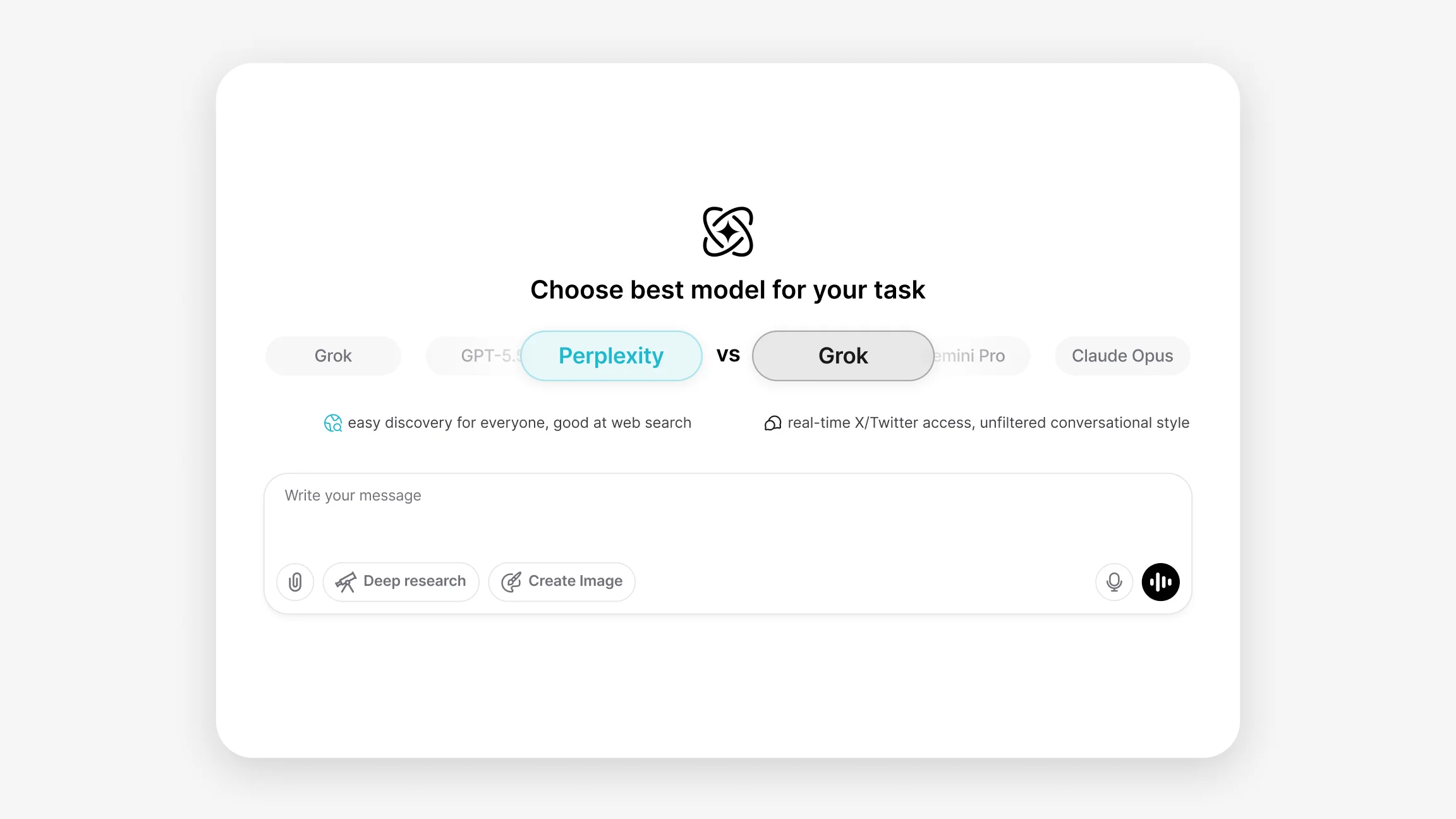
Chat & Ask AI brings both systems into the same interface, so a research session can start with Perplexity-based retrieval and continue with Grok-based conversational follow-up without switching platforms. The Perplexity model is available directly, and Grok 4.3 is accessible alongside every other leading AI model in the same workspace. Chat & Ask AI itself handles text, images, documents, and voice within a single session, which means the research to draft workflow stays in one place throughout. Access Perplexity and Grok together through Chat & Ask AI and compare how each one fits your own research and writing tasks.

Perplexity vs Grok reflects two different philosophies: structured, source-backed retrieval on one side, and fast, conversational real-time access on the other. Which one fits depends on whether a workflow needs traceable citations or rapid iteration.


FAQ

Frequently Asked Questions

What is the difference between Perplexity and Grok?

Perplexity, powered by the Sonar model family, focuses on sourced research summaries with explicit citations. Grok, powered by xAI's Grok 4 series, focuses on fast conversational replies with real time web and X platform access. They differ in response style, source handling, and workflow fit.

Is Perplexity better than Grok for research?

For structured research that requires source traceability and cited outputs, Perplexity is the stronger fit. Grok suits exploratory research and fast topic scanning better than documentation grade fact finding.

Is Grok better than Perplexity for real time information?

Grok is designed for near real time data access, pulling from live web sources and the X platform. Perplexity also incorporates web search but emphasizes indexed sources and structured retrieval over immediacy.

Which is more accurate, Perplexity or Grok?

Accuracy depends on the task. Perplexity's source backed responses make it easier to verify factual claims. Grok synthesizes information quickly but with fewer inline citations, which makes independent verification more manual.

How do Perplexity and Grok compare in research workflows?

Perplexity suits step by step research: query, cited results, structured summary. Grok suits iterative exploration: open a thread, ask follow-ups, refine through quick turns. Most research workflows benefit from both at different stages.

Does Grok provide real time internet access?

Yes. Grok, powered by xAI's Grok 4 series, includes live web search and access to the X platform, making it well suited to queries about fast moving topics and recent developments.

Does Perplexity show sources for its answers?

Yes. Perplexity surfaces explicit citations and referenced snippets alongside every response, which is central to its design for research and fact checking workflows.

Which is faster, Perplexity or Grok?

Grok is optimized for low latency replies and quick conversational turns. Perplexity prioritizes thoroughness over speed, which means responses can take slightly longer when deep retrieval is involved.

How do Perplexity and Grok differ in response style?

Perplexity returns structured summaries, lists, and sourced passages. Grok returns shorter conversational replies with follow-up prompts, suited to back and forth exploration rather than one-shot research queries.

Can Perplexity and Grok be used for daily tasks?

Yes. Perplexity fits daily tasks that involve looking something up accurately, such as checking facts or summarizing a topic. Grok fits daily tasks that involve rapid drafting, quick Q&A, or tracking live topics.

Which Chat & Ask AI models correspond to Perplexity and Grok?

Chat & Ask AI provides access to the Perplexity model and Grok 4.3, both available within the same multi-model interface alongside every other leading AI model.

How does Perplexity vs Grok compare to other models like ChatGPT or Claude?

Each model handles research and conversation differently. Chat & Ask AI gives access to Perplexity, Grok 4.3, ChatGPT, Claude, and others in one interface, so the comparison can be tested directly on the same prompt.