Perplexity vs DeepSeek: Feature Comparison

Perplexity vs DeepSeek covers two systems built around different core workflows. Perplexity focuses on sourced information retrieval and structured research summaries, while DeepSeek focuses on stepwise reasoning, coding, and logic driven problem solving. Understanding where each fits helps match the right tool to the right task.

Date June 30, 2026 · Emily Harrison

Understanding the Differences Between Perplexity and DeepSeek

Perplexity, powered by Perplexity AI's Sonar model family including Sonar, Sonar Pro, and Sonar Deep Research, is built around search-oriented workflows. It retrieves information from indexed web sources, attaches explicit citations to every response, and structures output as sourced summaries rather than extended reasoning chains. The Perplexity technology page covers how Sonar-based retrieval handles source attribution and structured information delivery across research and fact-checking tasks.

DeepSeek, powered by the DeepSeek V4 and R1 model families, is built around structured reasoning and computation. It breaks problems into logical steps, preserves intermediate calculations, and produces detailed chain of thought style outputs suited to coding, mathematics, and analytical workflows. The DeepSeek technology page covers how the V4 and R1 series handle multi-step reasoning, open-weights availability, and logic-driven response generation.

Feature / Task Area Perplexity (Sonar) DeepSeek (V4 / R1)
Primary Focus Search oriented research workflows, information retrieval, summarization. Structured reasoning workflows, coding, stepwise problem solving. Logic Leader
Response Style Concise summaries with source citations and links. Detailed, step by step explanations and internal reasoning traces.
Citations & Sources Explicit citations, quoted snippets, and external links for fact checking. Citation Master Limited external citation; emphasizes internal logic and verifiable steps.
Research Workflows Designed for gathering sources, quick literature overviews, and fact checks. Fact Finder Can support research that requires detailed reasoning or derivations.
Coding Workflows Useful for finding docs, examples, and quick code snippets. Suited for debugging, algorithm design, and multi step code reasoning. Algorithm Master
Math & Logic Provides summarized math answers and referenced resources. Provides step based math reasoning and intermediate calculations. Math & Computation Master
Long Context Handles long context with focused retrieval of relevant passages. Handles long context with preserved reasoning chains across steps.
Interaction Style Query to cited answer to follow up retrieval. Query to reasoning steps to iterative refinement of solution.
Traceability High for external sources and provenance. High for step level reasoning and internal verification.
Latency Optimized for quick, search style responses. Low Latency Can be longer due to multi step reasoning and computation.
Productivity Fit Research summaries, briefs, and knowledge discovery. Technical write ups, code tasks, and analytical workflows.
Integration Often used as an AI chat search layer or citation aware assistant. Often used as a coding assistant or logic engine; available as open weights for self hosting. Self-Hosted Open Weight

Research and Web Answers

Perplexity is purpose-built for research workflows. Responses come with cited sources and referenced snippets, making it straightforward to verify a claim or trace where a fact originated. Sonar Pro and Sonar Deep Research extend this into longer research sessions where a topic needs to be covered from multiple angles with clear provenance. The AI Search Engine follows the same retrieval logic, pulling answers across multiple web sources rather than relying on a single pass.

DeepSeek can support research that requires derivation or detailed explanation rather than source aggregation. It does not surface external citations in the same structured way, so it fits best when the research task is analytical rather than source-dependent.

Coding and Technical Tasks

DeepSeek is the stronger fit for coding workflows. The R1 model family is designed for algorithm design, debugging, and multi-step code reasoning, preserving intermediate logic so the reasoning behind a solution is traceable. It handles complex programming tasks that require iterative refinement across several steps without losing earlier context.

Perplexity contributes to coding workflows at the lookup stage, surfacing documentation, code examples, and quick reference answers from indexed sources. For tasks that go beyond lookup into actual implementation and debugging, DeepSeek's reasoning-focused architecture handles the heavier lifting. The AI Chat PDF covers a related use case, working through technical documents and long reference files that feed into both research and coding tasks.

Writing and Content Creation

Neither Perplexity nor DeepSeek is primarily a writing tool, but both contribute to content workflows at different stages. Perplexity fits the research phase, collecting cited sources and structured summaries that can inform a draft. DeepSeek fits the analytical phase, working through arguments, outlines, or logic-heavy sections that need step by step construction. The AI Writer handles the drafting layer directly, working with material gathered from either system.

Using Perplexity and DeepSeek Through Chat & Ask AI

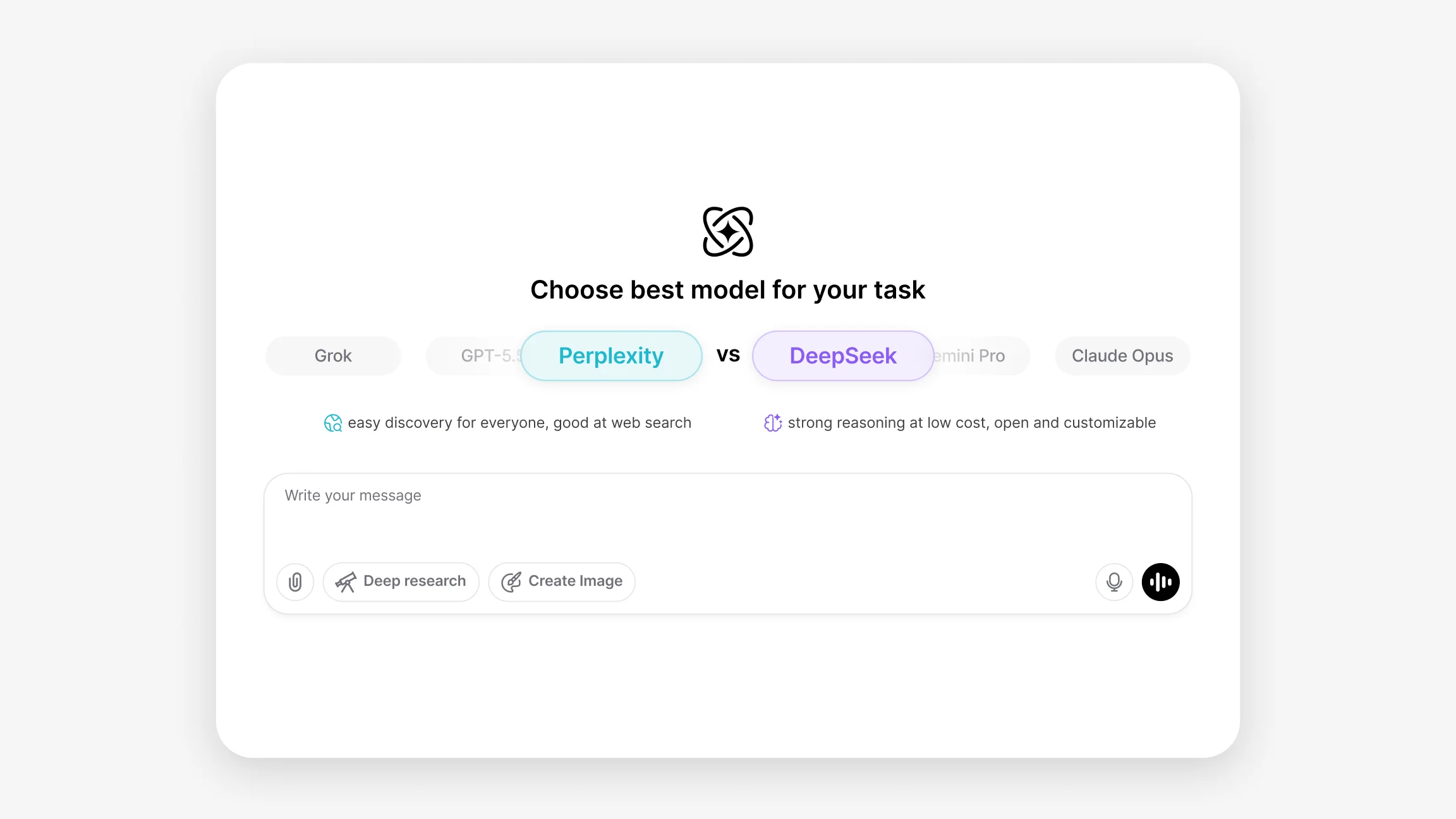
Chat & Ask AI brings both systems into the same interface, so a workflow can move from Perplexity-based source retrieval into DeepSeek-based reasoning without switching platforms. The Perplexity model and DeepSeek-V4-Pro alongside DeepSeek-V4-Pro Thinking are all accessible within the same workspace, together with every other leading AI model. Chat & Ask AI itself handles text, images, documents, and voice within a single session, which means research, reasoning, and drafting tasks stay in one place throughout. Access Perplexity and DeepSeek together through Chat & Ask AI and compare how each one fits your own workflows.

Perplexity vs DeepSeek reflects a clear split between sourced retrieval and structured reasoning. Perplexity fits tasks that need traceable citations and quick information summaries; DeepSeek fits tasks that need logical depth, code generation, and step-by-step computation.


FAQ

Frequently Asked Questions

What is the difference between Perplexity and DeepSeek?

Perplexity, powered by the Sonar models, centers on search style retrieval and source backed summaries. DeepSeek, powered by the DeepSeek V4 and R1 models, emphasizes structured reasoning, multi step logic, and technical problem solving.

Is Perplexity better than DeepSeek for research?

For gathering sources, quick literature overviews, and referenced summaries, Perplexity aligns with research workflows that prioritize provenance. DeepSeek remains useful for research needing deeper analytical steps.

Is DeepSeek better than Perplexity for coding?

For stepwise debugging, algorithm design, and multi phase coding tasks, DeepSeek aligns with coding workflows because of its structured reasoning outputs and preserved intermediate states.

Which tool is more accurate, Perplexity or DeepSeek?

Accuracy depends on task type and measurement. For source backed factual checks, Perplexity's citation behavior improves traceability. For logical correctness in multi step problems, DeepSeek's stepwise reasoning supports internal verification. Neither guarantees perfect accuracy in all cases.

How do Perplexity and DeepSeek compare in reasoning tasks?

Perplexity delivers concise, sourced results suited for quick answers. DeepSeek delivers extended reasoning chains and intermediate steps suited to complex problem solving and math reasoning, with R1 built around chain of thought reasoning.

Does Perplexity provide sources for its answers?

Yes. Perplexity, powered by the Sonar models, typically returns explicit sources, quoted excerpts, and links to support fact checking and provenance.

Does DeepSeek support real time web access?

DeepSeek, powered by the DeepSeek V4 and R1 models, is designed for internal reasoning and computation. Real time web access depends on specific integration and deployment; DeepSeek's primary pattern emphasizes logic and stepwise outputs rather than search style sourcing.

Which tool is better for studying, Perplexity or DeepSeek?

For study workflows needing referenced facts and quick summaries, Perplexity's sourcing is useful. For studying with worked examples, step by step problem solving, and coding practice, DeepSeek's reasoning style is useful.

How do Perplexity and DeepSeek differ in response style?

Perplexity returns concise, citation rich answers suited for information retrieval. DeepSeek returns detailed, step oriented explanations that show intermediate logic and computations.

Can Perplexity and DeepSeek be used together in workflows?

Yes. Combining Perplexity's source backed retrieval with DeepSeek's stepwise reasoning supports workflows that need both external evidence and internal verification, especially for technical research and coding tasks.