Writing and Content Creation
ChatGPT produces structured, well formatted writing with minimal setup. Articles, summaries, emails, and long-form drafts follow consistent tone and formatting patterns shaped by GPT-5's instruction tuning, which makes it a practical fit for content workflows that need reliable output without configuration overhead. The AI Writer operates on the same principle, handling drafting tasks directly within a single interface.
Llama can match a specific domain voice or editorial style after fine tuning, which matters in regulated industries or organizations with strict brand requirements. Out of the box, without fine tuning, writing quality depends heavily on the deployed variant and prompt engineering applied locally.
Coding and Technical Tasks
ChatGPT is optimized for interactive coding assistance. Multi turn debugging, code generation, refactoring, and step by step explanation all work well through the hosted interface or API, with GPT-5's reasoning architecture keeping track of earlier context across a session. For teams that need quick iteration without infrastructure setup, this is the lower-friction path.
Llama fits coding workflows where the model runs inside a private pipeline. Custom CI/CD integration, private inference, and on-premise code analysis are all achievable with Llama 4, particularly for organizations that cannot send code to external cloud endpoints for compliance reasons. Setup requires infrastructure work, but the result is a fully controlled coding environment.
Deployment, Privacy, and Customization
This is where Llama vs ChatGPT diverges most clearly. Llama's open-weight design means model weights are downloadable, deployable locally, and fine-tunable on proprietary datasets. Organizations with strict data residency requirements, regulated data environments, or experimental research needs use Llama specifically because nothing leaves their own infrastructure. The Marketing Assistant represents the opposite end of this spectrum, a hosted tool that handles campaign and content tasks without any infrastructure management required.
ChatGPT operates through provider-managed endpoints. Enterprise controls are available, but data handling follows OpenAI's service terms rather than a fully self-governed setup. For most teams, this tradeoff is acceptable given the speed of integration and the breadth of prebuilt SDK support.
Using Llama and ChatGPT Through Chat & Ask AI
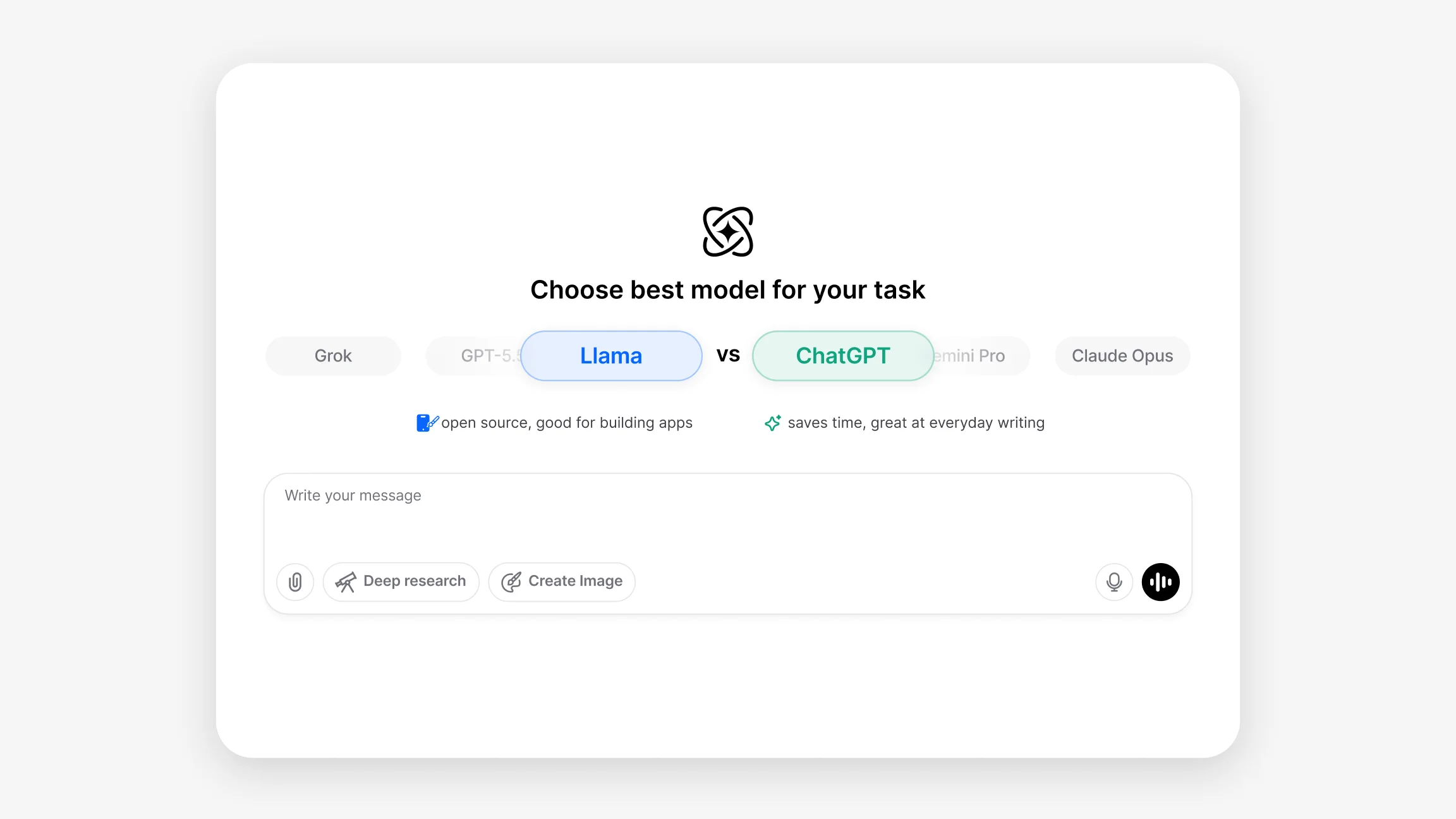
Chat & Ask AI brings both model families into the same interface, removing the infrastructure barrier that typically separates Llama access from ChatGPT access. Llama 4 and GPT-5.5, GPT-5, and GPT-4o are all available within the same workspace alongside every other leading AI model. Chat & Ask AI itself handles text, images, documents, and voice within a single session, which means a workflow can move from ChatGPT-based drafting to Llama-based evaluation without switching platforms. Access Llama and ChatGPT together through Chat & Ask AI and compare how each one fits your own workflows.
Llama vs ChatGPT comes down to control versus convenience. Llama fits workflows that need local deployment, fine-tuning, and full data governance. ChatGPT fits workflows that need fast integration, consistent conversational output, and managed cloud performance across writing, coding, and research tasks.

 AI Search Engine
 AI Image Generator
 AI Youtube Analyzer
 Whatsapp Integration