Gemini vs Grok: Feature Comparison for AI Workflows

Gemini vs Grok covers two multimodal systems that handle research, coding, and content tasks through different workflow approaches. Gemini focuses on large context document analysis and productivity oriented integrations, while Grok focuses on fast responses, live data access, and rapid iteration across current topics.

Date June 30, 2026 · Emily Harrison

Understanding the Differences Between Gemini and Grok

Gemini, powered by Google's Gemini 3 model family including Gemini 3.1 Pro and Gemini 3.5 Flash, is built around large-context handling and native multimodal processing. It takes in text, images, and documents within the same session, maintains context across extended conversations, and integrates with Google productivity tools for document-centered workflows. The Gemini technology page covers how the Gemini 3 series handles long-context reasoning, multimodal inputs, and adaptive task execution across research and drafting workflows.

Grok, powered by xAI's Grok 4 model series including the current Grok 4.3 release, is built around fast response generation and live data access. It draws from real-time web search and the X platform to surface current information quickly, favoring concise, direct answers over extended reasoning chains. The Grok technology page covers how the Grok 4 series handles live search, multimodal inputs, and speed-oriented interaction across dynamic topics.

Feature area Gemini (Gemini 3) Grok (Grok 4 / 4.3)
Real-time Info Integrates with broader system environments; can reference updated context when connected to live data sources. Designed for rapid access to recent data and live updates, with built in web and X search; optimized for current topics. Live X Search
Coding Workflows Handles large codebases and long context debugging; supports multi-file reasoning and stepwise explanations. Repository Scale Excels at quick code snippets, rapid iterations, and fast suggestions for immediate fixes.
Multimodal Strong multimodal support for images, documents, and long context cross references. Native Multimodal Supports multimodal inputs with emphasis on fast interpretation and short visual summarization.
Research Tasks Suited for deep research tasks that require sustained context, citations across documents, and multi-step synthesis. Deep Synthesis Suited for rapid literature scans, quick summaries of recent findings, and extracting timely highlights.
Image Generation Works well when image prompts are part of long form projects and document workflows. Generates images efficiently for quick visual drafts and real-time creative iterations. Real-Time Creative
Response Tone Adaptive, context rich, and continuity focused; responses often maintain tone across long sessions. Direct, concise, and speed oriented; responses favor immediacy and brevity.
Productivity Fit Integrates with document tools and workflows that need long context memory and task chaining. Task Chaining Integrates with live feeds and quick task loops where short term context and speed matter.
Long Context Strong long context capabilities for extended dialogs, multi-document workflows, and project level context. Long Context Leader Effective within shorter sessions; best for fast turn-taking and rapid context refresh.

Research and Web Answers

Gemini suits research tasks where the source material is already available. Its large context window handles full reports, document sets, and extended reference files in a single session without losing earlier context. For deep synthesis across long documents, Gemini's architecture is designed for sustained multi-step analysis. The AI Search Engine complements both systems, pulling answers from multiple live web sources when the research task requires current information rather than document level analysis.

Grok approaches research through live retrieval. It pulls from real-time web sources and the X platform, making it well suited to tracking recent developments, scanning current findings quickly, and extracting timely highlights from fast-moving topics. For research that needs depth over breadth, Gemini holds more context. For research that needs recency over depth, Grok's live access is the more direct path.

Turning Prompts Into Images

Both Gemini and Grok support image generation from text prompts, but they fit different points in a visual workflow. Gemini handles image generation as part of longer, document integrated projects where visual output connects to broader written context across the same session. Grok generates images efficiently for quick visual drafts and rapid creative iterations where speed matters more than extended context. The AI Image Generator handles prompt-based image generation directly, with output quality in both systems depending on how specific and detailed the prompt is.

Coding and Technical Tasks

Gemini's large context window makes it well suited to coding tasks that span multiple files, require long context debugging, or involve reviewing an entire codebase in one session. Its stepwise explanations and context retention across extended sessions support iterative development workflows where earlier decisions need to stay in scope.

Grok handles coding tasks that need quick answers. Code snippets, fast fixes, and rapid iteration cycles benefit from Grok's low-latency responses and direct output style. For tasks where a working answer in the next reply matters more than a full architectural review, Grok's speed oriented approach fits the workflow.

Using Gemini and Grok Through Chat & Ask AI

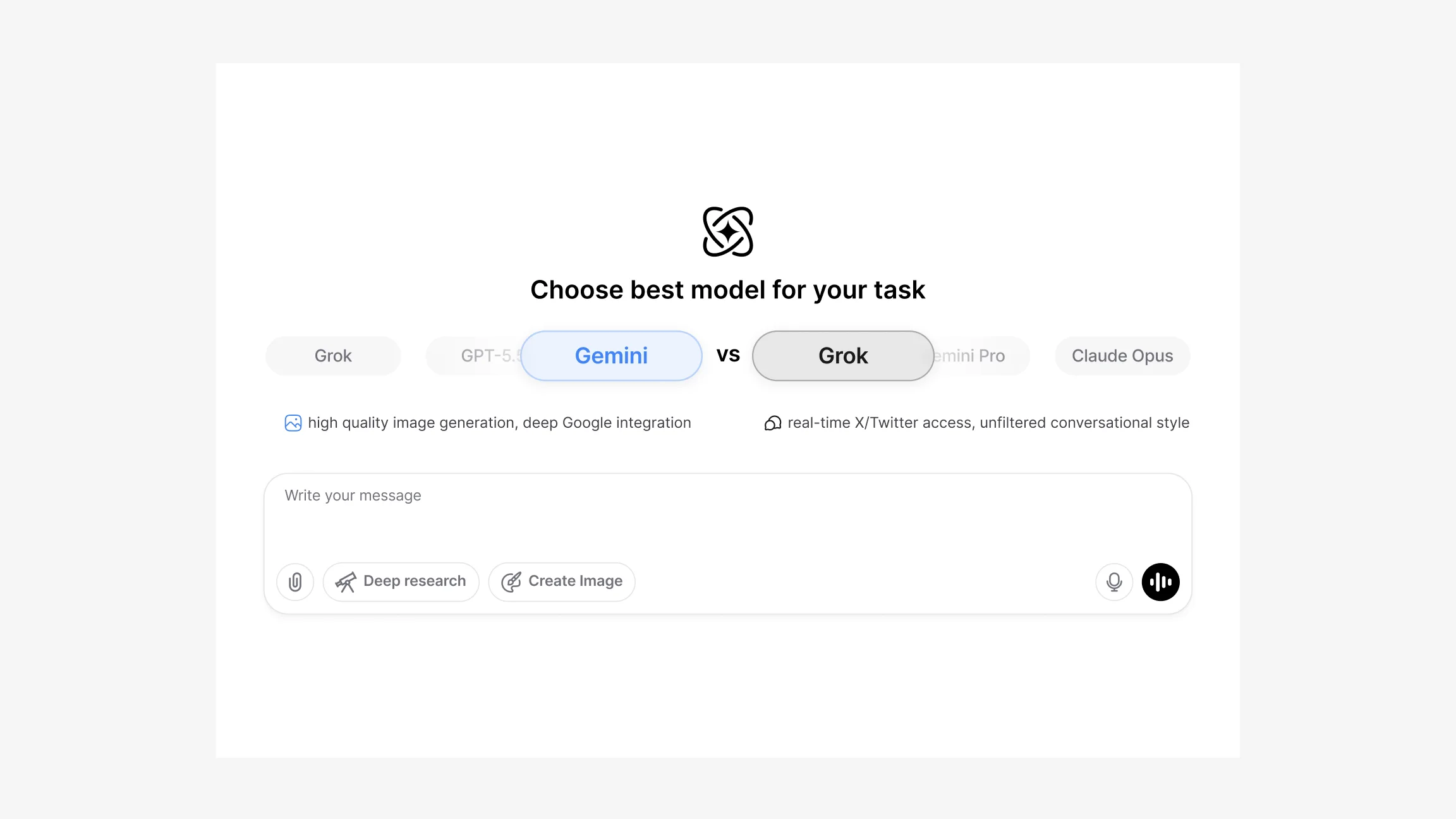
Chat & Ask AI brings both systems into the same interface, so a workflow can move from Gemini-based document analysis into Grok-based live data retrieval without switching platforms. Gemini 3.1 Pro, Gemini 3.5 Flash, and Grok 4.3 are all accessible within the same workspace alongside every other leading AI model. Chat & Ask AI itself handles text, images, documents, and voice within a single session, which means research, drafting, and real-time lookup tasks stay in one place throughout. Access Gemini and Grok together through Chat & Ask AI and compare how each one fits your own workflows.

Gemini vs Grok reflects a clear difference in workflow emphasis. Gemini fits tasks that need large-context document handling, sustained multimodal analysis, and productivity-tool integration. Grok fits tasks that need fast responses, live data access, and rapid iteration across current topics.


FAQ

Frequently Asked Questions

What is the difference between Gemini and Grok?

Gemini focuses on large context tasks, multimodal handling, and document centered workflows. Grok focuses on fast responses and up to date information from continuously refreshed sources, including live web and X search. Both serve different workflow patterns in research, coding, and content work.

Which is better for real time information, Gemini or Grok?

For live updates and recent events, Grok is commonly used for quick retrieval. Gemini can access updated data when integrated with live sources but is typically chosen for workflows that need broader context.

Is Gemini better than Grok for coding?

Gemini often handles long context coding tasks, multi file reasoning, and stepwise debugging. Grok is often preferred for fast snippets, quick fixes, and rapid iteration.

Is Grok better than Gemini for current events and trends?

Grok is typically geared toward current events and trend summaries due to its real time data focus. Gemini can summarize current content within longer research workflows when connected to live sources.

How do Gemini and Grok differ in research workflows?

Gemini is commonly used for deep research requiring sustained context, document cross references, and structured synthesis. Grok is used for rapid scans, timely summaries, and extracting recent highlights.

Which model is better for long documents, Gemini or Grok?

Gemini is generally better suited to long documents and extended context handling. Grok handles shorter sessions and quick document summaries efficiently.

How do Gemini and Grok compare in image generation?

Both support image generation. Gemini fits projects that tie images to larger document workflows, while Grok works well for fast visual drafts and quick creative experiments.

Which AI assistant is more conversational, Gemini or Grok?

Gemini tends to maintain continuity and adapt tone across extended conversations. Grok is more concise and oriented toward quick exchanges.

Can Gemini and Grok both handle multimodal tasks?

Yes. Both models support multimodal tasks; Gemini emphasizes deep multimodal workflows and long context coordination, while Grok emphasizes quick multimodal interpretation and speed.

Which model is better for productivity workflows, Gemini or Grok?

Productivity needs determine the choice: Gemini suits workflows that require chaining tasks and long term context; Grok suits workflows needing fast answers and up to date information.