Gemini vs DeepSeek: Feature Comparison for Coding and AI Workflows

Gemini vs DeepSeek covers two model families with distinct workflow orientations. Gemini focuses on multimodal inputs, large context handling, and productivity connected workflows, while DeepSeek focuses on structured reasoning, stepwise problem solving, and technical depth across coding and math heavy tasks.

Date June 30, 2026 · Emily Harrison

Understanding the Differences Between Gemini and DeepSeek

Gemini, powered by Google's Gemini 3 model family including Gemini 3.1 Pro and Gemini 3.5 Flash, is built around adaptive, context aware responses across text, images, and documents. It integrates with productivity tools, handles long context task switching, and supports multimodal workflows where different input types need to be processed together. The Gemini technology page covers how the Gemini 3 series handles multimodal reasoning, large-context comprehension, and document-centered workflow integration.

DeepSeek, powered by the DeepSeek V4 and R1 model families, is built around structured reasoning and explicit chain of thought outputs. It produces stepwise explanations, intermediate calculations, and reproducible logical steps suited to coding, mathematics, and analytical problem solving. The DeepSeek technology page covers how the V4 and R1 series handle multi-step reasoning, open weights deployment, and technical validation workflows.

Feature area Gemini (Gemini 3) DeepSeek (V4 / R1)
Coding & Debugging Good at contextual fixes across files and in document edits; handles code alongside docs and comments; useful for patch suggestions and inline explanations. Produces structured code with clear step by step reasoning; preferred for algorithmic problem solving, formal proofs of correctness, and detailed debugging traces. Algorithm Master
Reasoning & Math Supports high level reasoning and applied math inside broader context; can use external search context for up to date info. Emphasizes formal math reasoning, symbolic steps, and reproducible derivations; often outputs intermediate steps for verification. Math & Logic Leader
Multimodal Native multimodal support for text and images; can interpret screenshots, diagrams, and mixed media as part of the workflow. Native Multimodal Primarily optimized for text and structured inputs; some vision language capability in companion models.
Long Context Designed to follow long documents, summarize sections, and maintain context across task switches; integrates with document editors. Handles long technical documents by extracting structured summaries and stepwise analyses; supports logic-forward examination.
Research Tasks Works well with web connected tasks and document discovery; adapts responses using broader web or system context. Focuses on structured extraction, citation style reasoning, and reproducible analysis; often used for technical literature review.
Workflow Fit Fits productivity driven and multimodal workflows where context switching and integration with apps matter. Fits developer focused, analytical, and math heavy workflows where stepwise logic and reproducibility matter. Developer Focused
Assistant Style Adaptive, conversational, and context aware; useful for iterative refinement and mixed media collaboration. Methodical, structured, and detail oriented; useful for explicit reasoning and technical validation.
Integration Model Built to connect with document editors, search, and productivity tools; supports multimodal inputs. Built to integrate with developer tools and analysis pipelines; open weights allow self hosted deployment. Self-Hosted Open Weight

Coding and Technical Tasks

DeepSeek is the stronger fit for coding tasks that require explicit reasoning traces. The R1 model family produces structured code with step by step explanations, formal proofs of correctness, and detailed debugging traces that make the logic behind a solution verifiable. Algorithm design, systematic debugging, and math-heavy technical work all benefit from DeepSeek's methodical output style. The AI Chat PDF handles a related use case, working through technical documentation and reference files that feed into both research and coding workflows.

Gemini handles coding tasks that sit within a broader document or productivity context. Inline code explanations, patch suggestions across files, and code that connects to surrounding comments or documentation all fit Gemini's context-aware approach. For tasks where code is one part of a larger workflow rather than the sole focus, Gemini's ability to hold extended context across different input types is a practical advantage.

Research and Web Answers

Gemini suits research tasks where documents and web-connected sources are already in hand. Its large context window allows full reports and document sets to be processed in a single session, with responses that adapt across task switches without losing earlier context. The AI Search Engine extends this further, pulling answers from multiple live web sources when the research task requires current information beyond what a document set covers.

DeepSeek contributes to research that requires structured extraction and reproducible analysis. Technical literature reviews, derivation-heavy topics, and research that needs explicit intermediate steps rather than high-level summaries fit DeepSeek's formal reasoning style better than its web retrieval capabilities.

Writing and Content Creation

Gemini produces adaptive, context-rich writing that maintains tone across long sessions and draws from surrounding document context. For drafts that reference earlier material or need to stay consistent across many paragraphs, Gemini's large-context architecture supports the full writing workflow. The AI Writer handles drafting directly, working with material gathered from either system.

DeepSeek contributes to writing tasks that are analytical or technical in nature, producing structured outputs with clear logical organization. For content that needs to walk through an argument step by step, present a formal analysis, or explain a complex technical topic with reproducible reasoning, DeepSeek's methodical style adds precision that more conversational models may not preserve.

Using Gemini and DeepSeek Through Chat & Ask AI

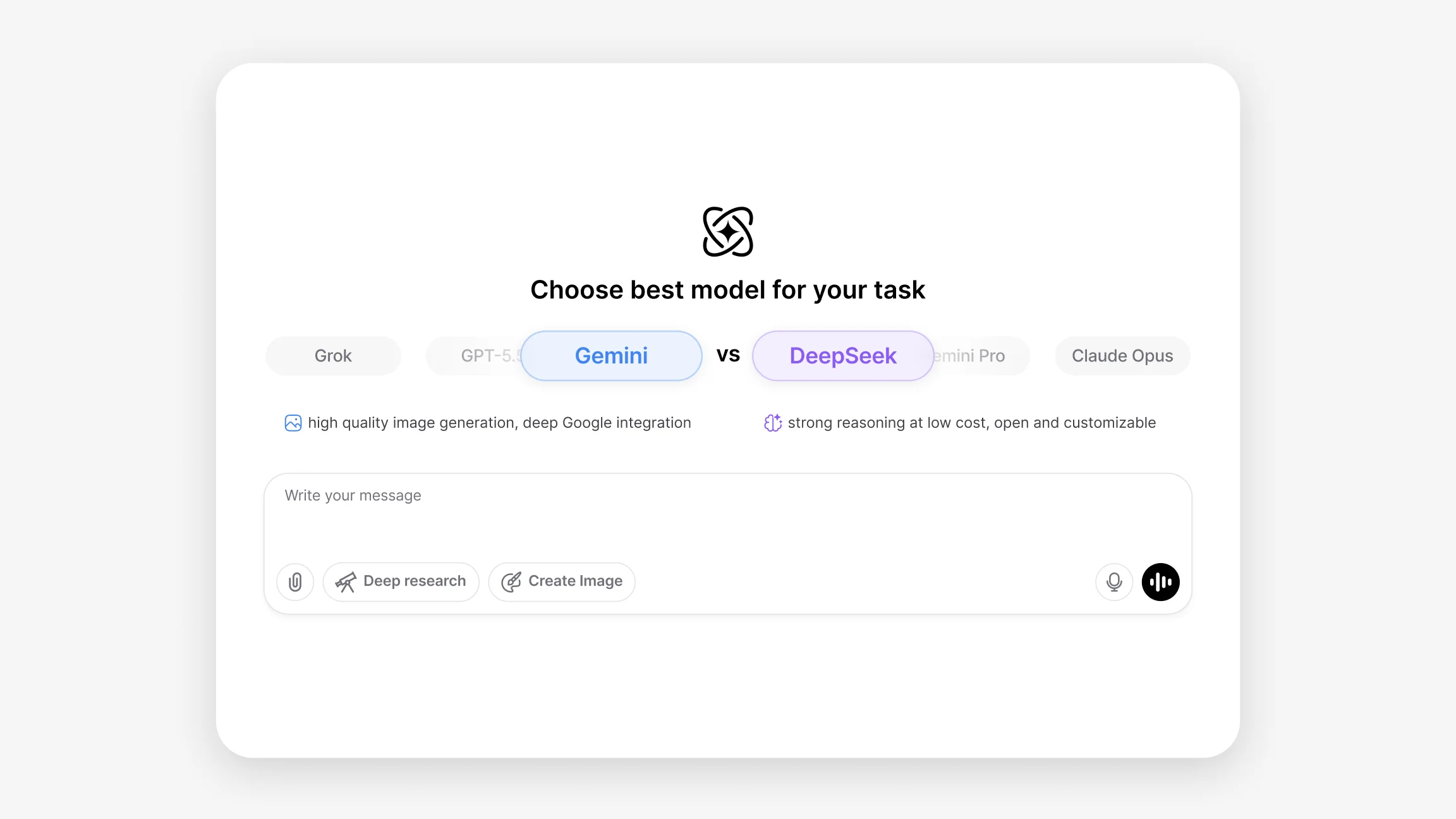
Chat & Ask AI brings both systems into the same interface, so a workflow can move from Gemini-based document analysis and multimodal handling into DeepSeek-based structured reasoning without switching platforms. Gemini 3.1 Pro, Gemini 3.5 Flash, DeepSeek-V4-Pro, and DeepSeek-V4-Pro Thinking are all accessible within the same workspace alongside every other leading AI model. Chat & Ask AI itself handles text, images, documents, and voice within a single session, which means research, coding, and drafting tasks stay in one place throughout. Access Gemini and DeepSeek together through Chat & Ask AI and compare how each one fits your own workflows.

Gemini vs DeepSeek reflects a clear difference in workflow design. Gemini fits tasks that need multimodal input handling, large-context productivity integration, and adaptive responses across document-centered work. DeepSeek fits tasks that need structured reasoning, explicit stepwise computation, and technical depth across coding and analytical workflows.


FAQ

Frequently Asked Questions

What is the difference between Gemini and DeepSeek?

Gemini is oriented toward multimodal, large context workflows and system integration, powered by the Gemini 3 models. DeepSeek is oriented toward structured reasoning, technical problem solving, and step based outputs, powered by the DeepSeek V4 and R1 models.

Which is better for coding, Gemini or DeepSeek?

For broader project context, documentation aware edits, and multimodal evidence, Gemini often matches those workflows. For algorithmic coding tasks, formal debugging traces, and stepwise verification, DeepSeek typically provides more structured outputs.

Is DeepSeek better than Gemini for math and reasoning?

DeepSeek emphasizes numbered steps and symbolic reasoning, which suits formal math and reproducible derivations, with R1 built around chain of thought reasoning. Gemini handles applied math inside larger contexts and supports references to external resources when needed.

Is Gemini better than DeepSeek for long documents?

Gemini is designed to maintain context across long documents and support document centered workflows. DeepSeek processes long documents in logical chunks and focuses on structured extractions and reproducible findings.

How do Gemini and DeepSeek differ in research workflows?

Gemini combines multimodal inputs and web connected context to synthesize broad research summaries. DeepSeek extracts precise claims, lists evidence, and formats results for technical review.

Which model is better for technical learning, Gemini or DeepSeek?

For exploratory learning with mixed media and broad context, Gemini supports interactive study. For step by step problem solving and rigorous walkthroughs, DeepSeek aligns with structured technical learning.

Can Gemini and DeepSeek both analyze files and documents?

Yes. Gemini works well with multimodal documents and long context summaries, while DeepSeek focuses on structured extraction, chunked analysis, and traceable reasoning.

How do Gemini and DeepSeek compare in multimodal tasks?

Gemini has broader native multimodal handling for images and mixed inputs in many workflows. DeepSeek offers some vision language capability through companion models but concentrates on text based structured reasoning.

What is the difference between Gemini Pro and DeepSeek R1 style workflows?

Workflows described as Gemini Pro style typically emphasize large context, adaptive, and multimodal integrations, powered by the Gemini 3 models. DeepSeek R1 style workflows emphasize structured, stepwise logic and reproducible reasoning, featured on the DeepSeek R1 reasoning model.

Which model handles broader productivity tasks better, Gemini or DeepSeek?

Gemini often aligns with productivity focused tasks that require context switching, document editing, and multimodal inputs. DeepSeek aligns with tasks that require strict logical steps, formal analysis, and developer centric outputs.