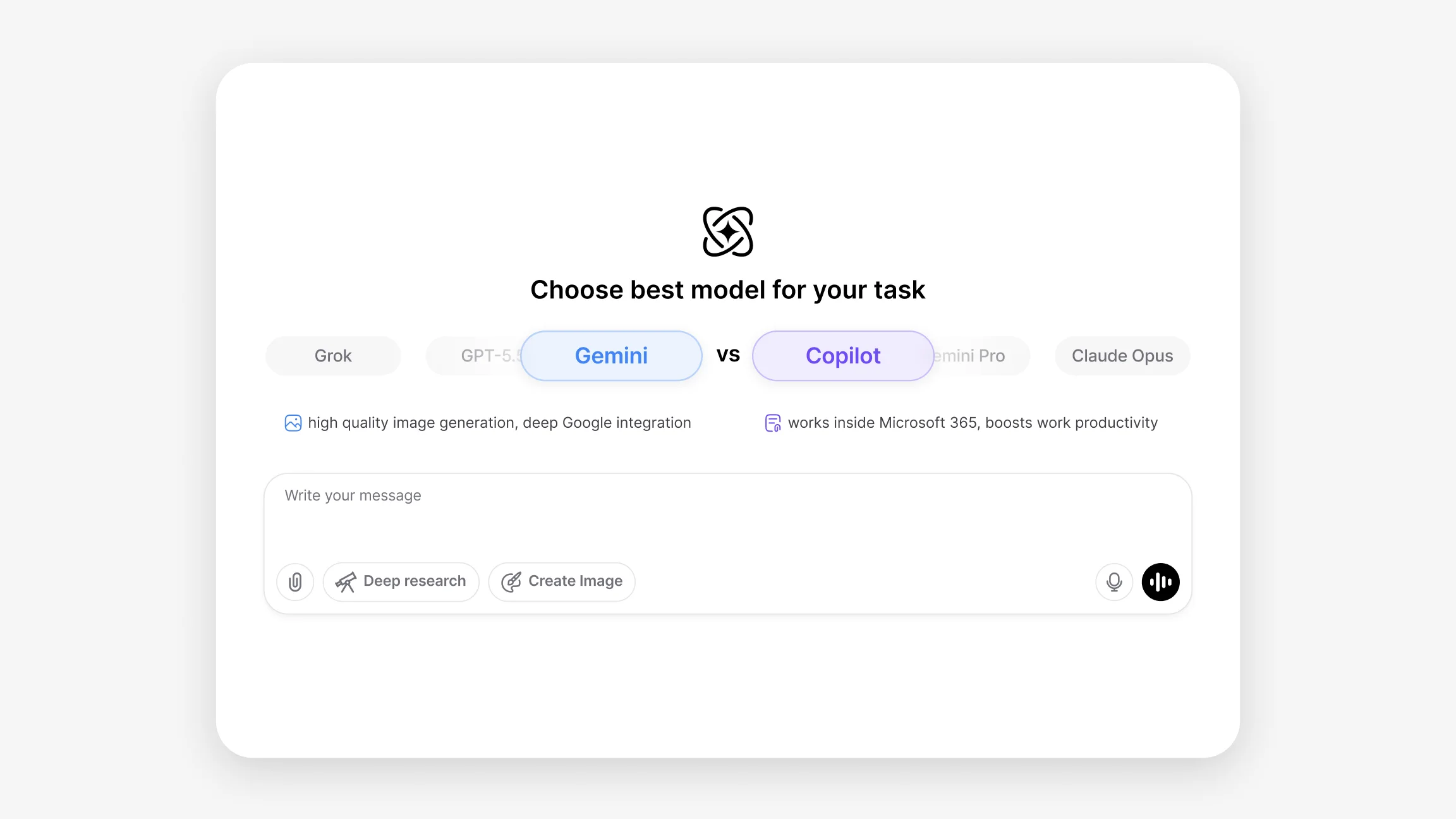
Gemini vs Copilot: Feature Comparison for AI Workflows

Gemini vs Copilot covers two systems with distinct workflow orientations. Gemini focuses on large context document analysis, multimodal inputs, and adaptive content workflows, while Copilot focuses on productivity inside Microsoft 365 apps and inline code assistance within developer toolchains.

Date June 30, 2026 · Emily Harrison

Understanding the Differences Between Gemini and Copilot

Gemini, powered by Google's Gemini 3 model family including Gemini 3.1 Pro and Gemini 3.5 Flash, is built around large-context handling and native multimodal processing. It takes in text, images, and documents within the same session, maintains context across extended conversations, and supports long-form summarization, structured reasoning, and document-centered workflows. The Gemini technology page covers how the Gemini 3 series handles multimodal inputs, large-context comprehension, and adaptive task execution across research and drafting workflows.

Copilot is deeply integrated into Microsoft 365 applications and developer toolchains. It assists with drafting and summarizing content inside Word, Outlook, and Teams, generates inline code completions within IDEs, and automates repetitive patterns across editor workflows. Because Copilot has no dedicated technology page, an additional feature link is included below in place of a technology page reference.

Feature area Gemini (Gemini 3) Copilot (M365 / GPT-5)
Primary Workflows Document workflows, long form content, multimodal tasks, structured reasoning. Productivity in Microsoft apps, inline code suggestions, editor integrations, repetitive code patterns. App Productivity
Context Length Strong at large context processing and cross document continuity. Long Context Leader Focused on immediate file, document, and editor context.
Multimodal Designed for text, images, and mixed inputs within one session. Native Multimodal Primarily code and text centric; integrates with IDEs and Microsoft 365 apps.
Writing & Content Long form drafting, summarization, style adaptation across documents. Short form edits, prompt-based snippets, template-based content generation.
Research Scope Comprehensive summaries across long documents, structured reasoning outputs. Deep Summary Quick fact retrieval and code related research; efficient for documentation lookup.
Coding Assistance Helps with architecture explanations, pseudo-code, and cross file reasoning. Generates inline code completions, refactors, and debugging hints within IDEs. Inline Leader
Debugging Provides reasoning and step explanations for issues across files. Offers concrete fix suggestions, test generation, and code patch proposals.
Ecosystem Fit Works well with document platforms and connected productivity ecosystems. Deep integration with code editors, version control, and Microsoft 365 apps. M365 Ecosystem
Response Style Explanatory, context aware, often longer form replies. Concise, task oriented, action focused suggestions.
Best Fit Tasks Content heavy workflows, research and summarization, multimodal projects. Daily development workflows, rapid coding, app and editor centric productivity.
Customization Adapts to broader prompts and multi-step workflows. Optimized for prompt snippets, inline prompts, and editor macros.

Writing and Content Creation

Gemini handles long form writing tasks with context awareness across the full session. Articles, structured documents, and multi section drafts benefit from Gemini's ability to hold tone and reference earlier material across extended inputs. The AI Writer handles drafting directly within a single interface, working with research material gathered from either system.

Copilot fits writing tasks that happen inside Microsoft 365 apps. Drafting emails in Outlook, generating document sections in Word, and summarizing meeting notes in Teams are all native use cases where Copilot's tight app integration reduces friction. For writing that lives outside the Microsoft ecosystem, Gemini's broader context handling covers more ground.

Coding and Technical Tasks

Copilot is purpose-built for developer workflows. Inline code completions, refactoring suggestions, test generation, and debugging hints within IDEs like VS Code are Copilot's primary coding use cases. Its responses are concise and action-oriented, delivering a working suggestion rather than a lengthy explanation. The AI Chat PDF handles a related use case, working through technical documentation and reference files that inform both research and coding tasks.

Gemini contributes to coding workflows that involve architecture level reasoning, cross file explanations, or code that connects to broader document context. For tasks where understanding the reasoning behind a solution matters as much as the solution itself, Gemini's explanatory style and large-context retention add depth that inline completion tools are not designed for.

Research and Web Answers

Gemini suits research tasks that involve long documents or multi source synthesis within a single session. Its large context window allows full reports and briefings to be processed without splitting them, with responses that adapt across task switches. The AI Search Engine extends this further, pulling answers from multiple live web sources when current information is needed alongside document-level analysis.

Copilot handles research tasks that are documentation adjacent, surfacing quick facts, summarizing files already open in a Microsoft app, and retrieving code related references efficiently. For research that goes beyond the immediate file or app context, Gemini's broader retrieval and synthesis capabilities handle more complex queries.

Using Gemini and Copilot Through Chat & Ask AI

Chat & Ask AI brings Gemini into the same interface alongside every other leading AI model, so workflows that benefit from Gemini's large context multimodal handling are accessible without switching platforms. Gemini 3.1 Pro and Gemini 3.5 Flash are available within the same workspace, and Chat & Ask AI itself handles text, images, documents, and voice within a single session. Access Gemini and other leading models together through Chat & Ask AI and compare how each one fits your own writing, research, and coding workflows.

Gemini vs Copilot reflects a difference in workflow scope. Gemini fits tasks that need large context document handling, multimodal input processing, and adaptive long-form content work. Copilot fits tasks that need tight app integration, inline code assistance, and productivity focused suggestions within Microsoft 365 and developer toolchains.


FAQ

Frequently Asked Questions

What is the difference between Gemini and Copilot?

Gemini, powered by the Gemini 3 models, focuses on large context document workflows, multimodal inputs, and structured reasoning. Copilot, powered by GPT-5 models integrated with Microsoft systems, focuses on app and editor level assistance, inline completions, and developer workflows.

Is Gemini better than Copilot for writing?

Gemini is commonly used for long form writing, summaries, and cross document editing. Copilot is more oriented toward short edits, in app drafting, and template generation within Microsoft or editor environments. The appropriate choice depends on whether the task needs broad context or quick edits.

Is Copilot better than Gemini for office work?

Copilot integrates tightly with Microsoft 365 apps and development tools. Gemini is often used for broader office document workflows and multimodal tasks. Performance varies by the specific office workflow and tool integrations.

Which model is better for research, Gemini or Copilot?

For large scale research and document summarization, Gemini's large context handling is generally more suitable. For code related research or quick documentation lookups, Copilot's app focused responses can be more efficient.

How do Gemini and Copilot compare for coding?

Copilot excels at inline code completion, snippet generation, and iterative coding inside IDEs. Gemini assists with architecture explanations, cross file reasoning, and explanatory pseudo code. Many development teams use Copilot for daily coding and Gemini for higher level design or documentation tasks.

Is Gemini better for personal use?

Gemini's multimodal and long context strengths fit personal projects that involve documents, images, or extended notes. Personal preference and the task workflow determine which model is more useful.

Is Copilot better for Microsoft 365 workflows?

Copilot is designed to work within Microsoft 365 apps and developer environments. For app centered tasks and developer integrations within Microsoft ecosystems, Copilot's connections can be helpful.

How do Gemini and Copilot differ in response style?

Gemini typically gives broader, context rich, explanatory responses. Copilot provides concise, task focused, actionable suggestions suited to coding, app, and editor tasks.

Which AI model is more useful for productivity tasks?

Usefulness depends on the task: document heavy or multimodal tasks often align with Gemini, while code automation, inline assistance, in app drafting, and editor tasks align with Copilot. Both contribute to productivity in different ways.

Can Gemini and Copilot both handle multimodal tasks?

Gemini, powered by the Gemini 3 models, is designed for multimodal inputs. Copilot, powered by GPT-5 models integrated with Microsoft systems, is primarily text and code focused; some integrations may support media handling depending on the environment.