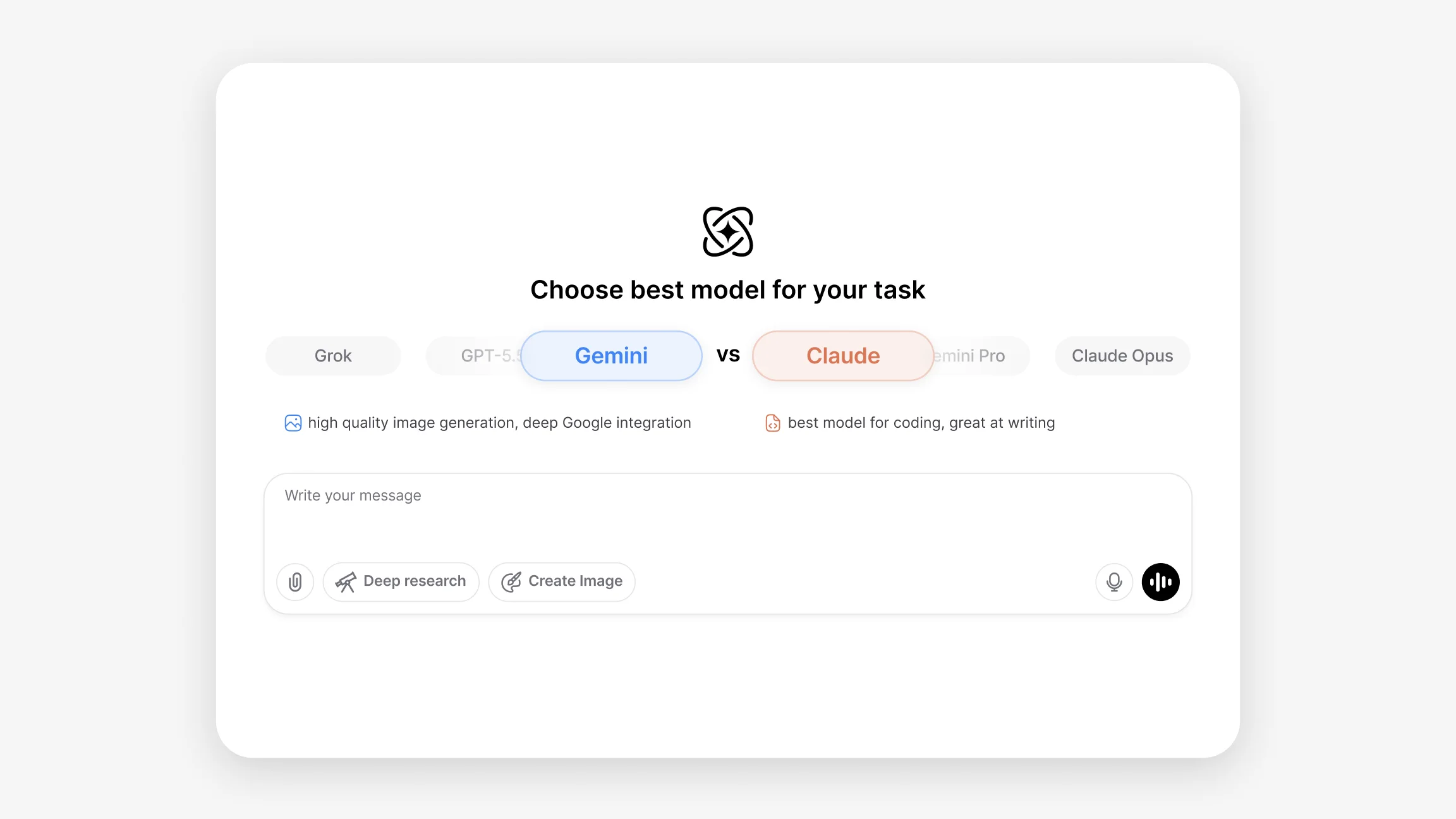
Gemini vs Claude: AI Models Comparison

Gemini vs Claude covers two model families that both handle writing, coding, and research but through distinct approaches. Gemini focuses on multimodal inputs, adaptive task switching, and productivity connected workflows, while Claude focuses on structured long form reasoning, careful response construction, and deep context handling across complex tasks.

Date June 30, 2026 · Emily Harrison

Understanding the Differences Between Gemini and Claude

Gemini, powered by Google's Gemini 3 model family including Gemini 3.1 Pro and Gemini 3.5 Flash, is built around native multimodal processing and large-context handling. It takes in text, images, and audio within the same session, adapts responses across dynamic task switches, and integrates with document and productivity tools. The Gemini technology page covers how the Gemini 3 series handles multimodal reasoning, large-context comprehension, and adaptive workflow integration.

Claude, built on Anthropic's Claude 4 model family including Claude Opus 4.8 and Claude Sonnet 4.6, is built around structured reasoning and careful, long-form response construction. It handles extended reasoning tasks with stepwise logic, produces detailed explanations for complex prompts, and maintains consistent voice and structure across large-context documents. The Claude technology page covers how the Claude 4 series handles deep context processing, chain-of-thought reasoning, and structured output generation across writing and analytical workflows.

Feature area Gemini (Gemini 3) Claude (Claude 4 family)
Coding Fast iterations, supports multimodal code contexts and quick debugging prompts; good for short to medium snippets and interactive fixes. Strong at structured debugging, explaining algorithm reasoning, and long horizon agentic coding with well documented examples. Agentic Master
Writing Adaptive tone control and multimodal prompts for content with images or references; concise drafts and rewrites. Suited for long form writing, careful structuring, and consistent voice across extended documents. Consistent Voice
Reasoning Efficient for mixed input reasoning and pragmatic answers across tasks; handles context switching during interactive sessions. Focused on step by step reasoning, decomposition of complex problems, and detailed chain of thought style outputs. Deep Decomp
Context Window Handles large inputs and multimodal context well, with emphasis on integrating external data and document snippets. Designed for deep long context handling with structured extraction, summaries, and multi section outputs. Long Form Leader
Multimodal Strong native support for images, audio, and text combined in a single workflow. Native Multimodal Supports text and image inputs; prioritizes structured text reasoning for large documents.
Research Workflows Good for fetching and integrating diverse data points, cross referencing documents, and quick fact check style tasks. Favored for in depth analysis, multi step literature synthesis, and producing organized research summaries.
Speed & Style Optimized for responsive interactions and dynamic task switching during live sessions, with fast Flash variants. Live Fast Often produces more deliberate, detailed responses suited to longer prompts and careful revision.
Integration Designed to work with productivity tools and broad system integrations for document handling and searches. Commonly used in workflows that require consistent structured outputs, templates, and long form document pipelines.

Writing and Content Creation

Claude is the stronger fit for long form writing that requires consistent voice, careful structuring, and detailed development across many paragraphs. Its deliberate response style preserves coherence across extended documents, making it well suited to research papers, in-depth articles, and multi-section content that needs to stay internally consistent. The AI Writer handles drafting directly, working with material gathered from either system.

Gemini contributes to writing workflows where content connects to images, references, or mixed media inputs within the same session. Adaptive tone control, quick rewrites, and content that needs to pull from external documents mid session fit Gemini's multimodal approach better than tasks that need extended single-voice development.

Coding and Technical Tasks

Claude handles complex coding tasks that require structured debugging, algorithmic reasoning, and long-horizon agentic execution. Its step by step logic and well-documented outputs make it particularly useful for tasks where understanding the reasoning behind a solution matters as much as the solution itself. For coding workflows that span multiple files or require iterative refinement with context retained throughout, Claude's architecture supports the full session without losing earlier decisions. The AI Chat PDF handles a related use case, working through technical documentation and reference files that feed into both research and coding workflows.

Gemini fits coding tasks that involve quick iterations, short to medium snippets, and interactive fixes where multimodal context, such as screenshots of error messages or diagrams, plays a role. Its fast Flash variants suit rapid coding cycles where immediate suggestions matter more than extended architectural reasoning.

Chatting With PDFs and Long Documents

Both models handle long documents, but with different approaches. Claude is designed for deep long-context processing, producing structured summaries, multi-section extractions, and carefully organized outputs from dense documents. For workflows where a long document needs to be read carefully and summarized with internal structure preserved, Claude's architecture is built for this task. The AI Chat PDF supports this use case directly, allowing documents to be uploaded and queried regardless of which model handles the analysis.

Gemini handles large-context inputs with an emphasis on integrating external data and cross-referencing document snippets across mixed inputs. For research that pulls from multiple sources and formats simultaneously, Gemini's multimodal context handling covers more ground in a single session.

Research and Web Answers

Claude suits research that requires multi-step literature synthesis, in-depth analysis, and organized summaries with clear internal structure. For research outputs that need to stand alone as well organized documents, Claude's reasoning architecture produces more deliberate, detailed results. The AI Search Engine complements both systems, pulling answers from live web sources when current information is needed alongside document-level analysis.

Gemini contributes to research workflows that involve cross-referencing diverse data points, quick fact checking, and integrating information from documents and web sources in the same session. For fast, iterative research that moves between formats and sources, Gemini's adaptive approach handles the context switching efficiently.

Using Gemini and Claude Through Chat & Ask AI

Chat & Ask AI brings both model families into the same interface, so a workflow can move from Gemini based multimodal handling into Claude based structured reasoning without switching platforms. Gemini 3.1 Pro, Gemini 3.5 Flash, Claude Sonnet 4.6, and Claude Opus 4.8 are all accessible within the same workspace alongside every other leading AI model. Chat & Ask AI itself handles text, images, documents, and voice within a single session, which means writing, coding, and research tasks stay in one place throughout. Access Gemini and Claude together through Chat & Ask AI and compare how each one fits your own workflows.

Gemini vs Claude reflects a clear difference in workflow design. Gemini fits tasks that need multimodal input handling, adaptive task switching, and productivity tool integration across mixed media. Claude fits tasks that need structured long-form reasoning, consistent voice across extended documents, and careful step by step analysis of complex problems.


FAQ

Frequently Asked Questions

What is the difference between Gemini and Claude?

Gemini, powered by the Gemini 3 models, emphasizes multimodal inputs, adaptive responses, and integration with productivity environments. Claude, built on the Claude 4 family, emphasizes structured long form reasoning, careful response construction, and detailed handling of large context inputs.

Is Claude better than Gemini for coding?

For complex, well documented solutions, stepwise debugging, and long horizon agentic coding, Claude often produces more structured, explanatory code. Gemini is useful for faster iterations and interactive debugging with mixed media context. Neither is inherently superior; each suits different coding workflows.

Is Gemini better than Claude for long documents?

Gemini handles large inputs and multimodal document fragments effectively. Claude focuses on deep long context reasoning and structured long document output. Choice depends on whether the workflow prioritizes multimodal integration or structured long form processing.

Which is better for writing, Gemini or Claude?

For quick drafts, tone shifts, and mixed media content, Gemini is commonly used. For extended essays, reports, or content that requires consistent structure and detailed reasoning, Claude is commonly chosen.

How do Gemini and Claude differ in research workflows?

Gemini supports broad data integration and quick cross referencing across sources. Claude supports multi step synthesis, detailed summaries, and structured literature style outputs. The workflow selection depends on whether speed and multimodal inputs or deeper synthesis are the priority.

Which model is better for Google Workspace tasks, Gemini or Claude?

Gemini is often aligned with productivity environments and integrations that connect to document and search tools. Claude is typically used where structured templates and long form document handling are central to the workflow.

Can both Gemini and Claude handle large context windows?

Yes. Both the Gemini 3 models and the Claude 4 family handle large context windows, but they apply different styles: Gemini emphasizes multimodal context integration and dynamic responses, while Claude emphasizes structured extraction and detailed long form processing.

Which model is better for multimodal tasks, Gemini or Claude?

Gemini is typically stronger for native multimodal tasks involving images, audio, and text together. Claude can process text and image inputs but is commonly used for text first, structured reasoning tasks.

How do Gemini and Claude compare for reasoning tasks?

Gemini provides efficient, pragmatic reasoning across mixed inputs and interactive sessions. Claude focuses on stepwise, in depth reasoning, making it suitable for multi part logical breakdowns and detailed explanations.

Which model is better for daily productivity, Gemini or Claude?

Gemini often fits workflows that require quick responses, multimodal support, and integrations with productivity tools. Claude is preferred for tasks needing careful structure, long form outputs, or extended reasoning. Selection depends on the day to day task profile.