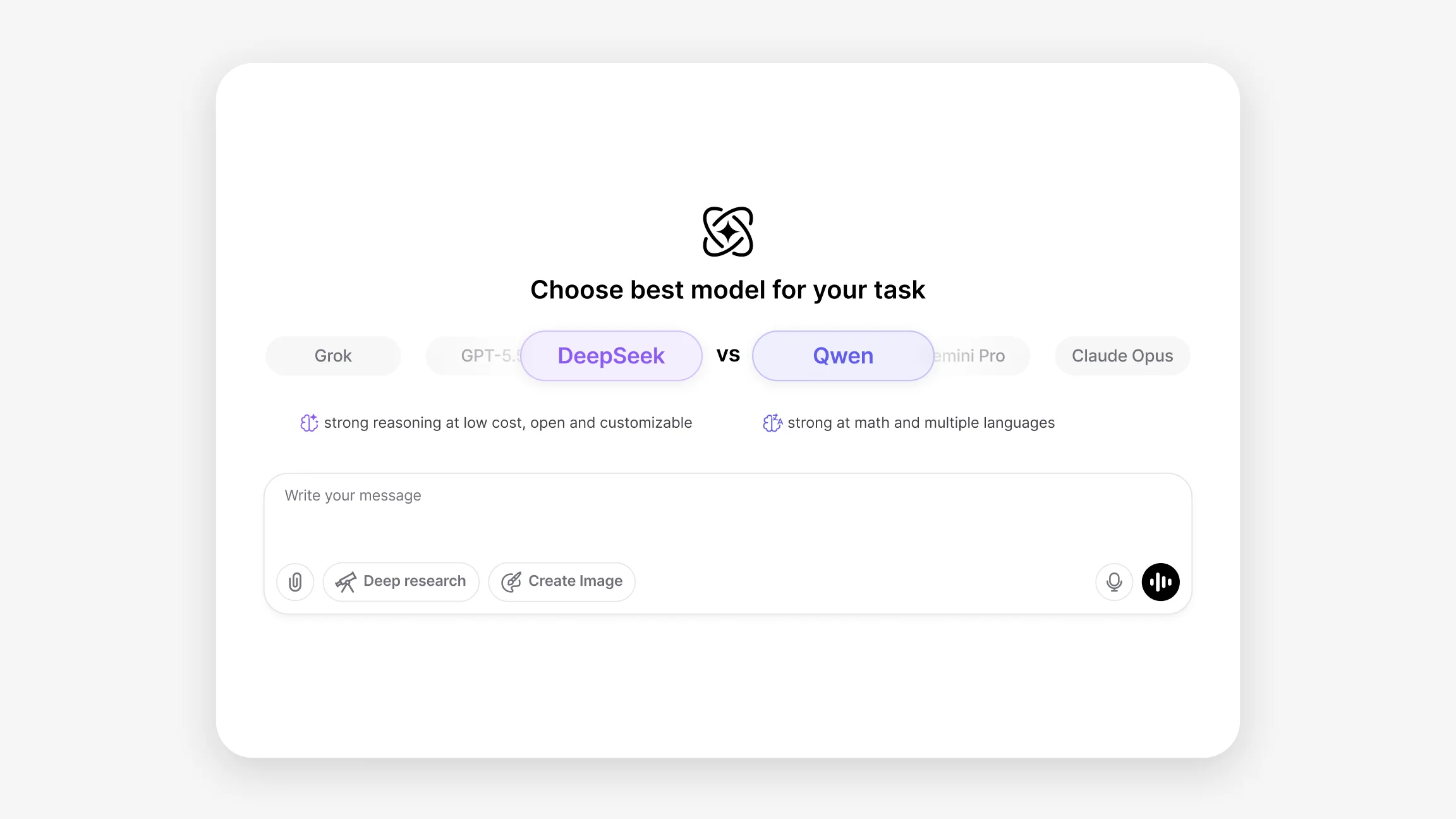
DeepSeek vs Qwen: Feature Comparison for AI Workflows

DeepSeek vs Qwen covers two model families built around different workflow priorities. DeepSeek focuses on structured reasoning, stepwise technical problem solving, and reproducible logic, while Qwen focuses on content fluency, multilingual generation, and multimodal document workflows.

Date June 30, 2026 · Grace Mitchell

Understanding the Differences Between DeepSeek and Qwen

DeepSeek, powered by the DeepSeek V4 and R1 model families, is built around explicit chain-of-thought reasoning and technical depth. It breaks problems into logical steps, preserves intermediate calculations, and produces structured outputs suited to coding, mathematics, and analytical workflows where reproducibility matters. The DeepSeek technology page covers how the V4 and R1 series handle multi-step reasoning, open-weights deployment, and logic-driven response generation.

Qwen, developed by Alibaba and powered by the Qwen 3 model family, is built around fluent content generation, multilingual output, and multimodal document handling. It produces narrative and document-style responses, supports over 100 languages and dialects, and handles image-aware document workflows through dedicated multimodal variants. Qwen has no dedicated technology page, so an additional feature link is included below in place of a technology page reference.

Feature area DeepSeek (V4 / R1) Qwen (Qwen 3 family)
Primary Focus Structured reasoning, technical problem solving, logic driven code generation. Logic Leader Structured content creation, multilingual text, multimodal document workflows.
Response Style Step by step, logic first, often uses numbered steps or explicit checks. Narrative and document style, fluent paragraphs, adapts tone for audience.
Coding Workflows Prefers explicit algorithmic steps, clear code comments, test case style outputs. Generates readable code snippets and accompanying explanations with dedicated Qwen Coder variants. Qwen Coder Native
Reasoning Depth Emphasizes step decomposition and intermediate logic traces with R1 chain of thought. Chain of Thought Hero Provides coherent argumentative text and concise summaries; handles context well.
Structured Output Strong at producing tightly structured formats (tables, step lists, formal proofs). Produces structured documents with natural flow (headings, multilingual formatting).
Multimodal Vision enabled variants focused on reasoning with visual inputs (vision plus logic). Broad multimodal support and image understanding, often used for document layout tasks. Layout Mastery
Multilingual Good support via translation focused prompts; emphasis on fidelity of reasoning. Strong multilingual generation and localization across 100+ languages and dialects. Multilingual SOTA
Long Context Maintains logical thread across longer reasoning sequences; structured checkpoints. Handles long contexts with narrative cohesion suited for long documents.
Speed Optimized for stepwise accuracy; prioritizes thoroughness over minimal latency. Optimized for fluent generation and multimodal batching, useful for high throughput.
Productivity Fit Favored where traceable logic, reproducibility, and technical rigor are important. Favored where multilingual content, image aware documents, and diverse media are required.
Model Posture Consistently releases open-weight flagship tiers that can be self-hosted. Open Weights Releases mid-tier open-weight models on Hugging Face; recent flagship Max tier is proprietary.
Integrations Code editors, analysis pipelines, math and logic tools. Document generation tools, content management systems, video pipelines.

Coding and Technical Tasks

DeepSeek is the stronger fit for coding workflows that require explicit algorithmic reasoning. The R1 model family produces structured code with step-by-step logic traces, formal verification-style outputs, and detailed debugging traces that make the reasoning behind a solution traceable. Algorithm design, math-heavy technical work, and systematic debugging all benefit from DeepSeek's methodical output style. The AI Chat PDF handles a related use case, working through technical documentation and reference files that feed into coding and analytical workflows.

Qwen contributes to coding through dedicated Qwen Coder variants that generate readable code snippets with clear accompanying explanations. For development workflows where code needs to integrate with multilingual documentation or image-aware content pipelines, Qwen's broader output capabilities cover ground that DeepSeek's reasoning-first approach is not optimized for.

Writing and Content Creation

Qwen is the stronger fit for content creation tasks. Its fluent paragraph-level generation, tone adaptation, and native multilingual support across 100+ languages make it well suited to document creation, localization, and content workflows that span multiple languages or formats. For high-throughput content generation across diverse media, Qwen's architecture handles multimodal batching efficiently. The AI Writer handles drafting directly within a single interface, working with material from either system.

DeepSeek contributes to writing tasks that are analytical or technical in nature, producing tightly structured formats such as tables, step lists, and formal proofs. For content that needs to present a logical argument with explicit intermediate steps, DeepSeek's reasoning-first style adds precision that more narrative-oriented models may not preserve.

Research and Web Answers

DeepSeek suits research tasks that require structured extraction, reproducible analysis, and derivation-heavy explanations. Technical literature review, formal reasoning chains, and research that needs intermediate steps preserved for verification fit DeepSeek's approach. The AI Search Engine complements both systems, pulling answers from live web sources when current information is needed alongside document-level analysis.

Qwen handles research tasks that involve long documents with narrative cohesion, multilingual source material, or image-containing documents. Its long context handling preserves document flow rather than reducing content to logical checkpoints, which suits research outputs that need to read as coherent documents rather than structured step lists.

Using DeepSeek and Qwen Through Chat & Ask AI

Chat & Ask AI brings both systems into the same interface, so a workflow can move from DeepSeek-based structured reasoning into Qwen-based multilingual content generation without switching platforms. DeepSeek-V4-Pro and DeepSeek-V4-Pro Thinking are accessible within the same workspace alongside every other leading AI model, and Chat & Ask AI itself handles text, images, documents, and voice within a single session. Access DeepSeek and other leading models together through Chat & Ask AI and compare how each one fits your own coding, writing, and research workflows.

DeepSeek vs Qwen reflects a clear difference in workflow design. DeepSeek fits tasks that need traceable stepwise reasoning, technical depth, and reproducible logic across coding and analytical work. Qwen fits tasks that need fluent multilingual content generation, multimodal document handling, and high throughput output across diverse formats.


FAQ

Freuquently Asked Questions

What is the difference between DeepSeek and Qwen?

DeepSeek, powered by the DeepSeek V4 and R1 models, favors structured, logic driven outputs and stepwise reasoning. Qwen, powered by the Qwen 3 family, emphasizes fluent content generation, multilingual support, and multimodal inputs like images.

Is DeepSeek better than Qwen for coding?

DeepSeek often produces more explicit step by step logic and checks useful in coding reasoning. Qwen generates clear, integration ready code with readable explanations, including dedicated Qwen Coder variants. Choice depends on whether stepwise traceability or document style code is more important.

Is Qwen better for content creation?

Qwen is commonly used for structured document creation and multilingual content generation, making it suitable for content focused tasks.

How do DeepSeek and Qwen compare in reasoning tasks?

DeepSeek emphasizes intermediate logic and structured reasoning. Qwen provides coherent narrative explanations and concise summaries. Both address reasoning but with different output styles.

Which model is faster, DeepSeek or Qwen?

Latency and throughput vary by model version and deployment. DeepSeek models may prioritize thoroughness for complex logic; Qwen models often target fluent generation and multimodal batching.

Does Qwen support multimodal inputs?

Yes. Qwen, powered by the Qwen 3 family, supports multimodal workflows and is commonly used with image and document inputs, with dedicated vision and OCR variants.

Is DeepSeek focused on technical tasks?

DeepSeek, powered by the DeepSeek V4 and R1 models, is commonly applied to technical tasks requiring structured reasoning, algorithmic steps, and analytical outputs.

How do their response styles differ?

DeepSeek tends to use step by step, logic first formats. Qwen favors fluent paragraphs, document style structure, and language sensitive outputs.

Which model is better for structured outputs?

DeepSeek often produces tightly structured formats such as numbered logic steps or formal tables; Qwen produces structured documents and localized content. The selection depends on whether strict logical structure or document flow is needed.

Can both models handle general AI tasks?

Yes. Both DeepSeek and Qwen can handle a wide range of general tasks, though each shows different tendencies in style, formatting, and multimodal handling. Both also offer open weight models for self hosting.