Coding and Technical Tasks
DeepSeek is the stronger fit for coding workflows that require explicit reasoning traces. The R1 model family produces structured code with step-by-step logic, formal verification-style outputs, and detailed debugging traces that make the reasoning behind a solution auditable. Algorithm design, systematic debugging, and math-heavy technical work all benefit from DeepSeek's methodical output style. For workflows where runnable examples and direct remediation steps matter most, DeepSeek's transactional approach delivers compact, testable outputs efficiently.
Claude handles coding tasks that require architecture-level reasoning, code review, and long-horizon agentic execution across multiple files. Its explanatory style and context retention across extended sessions suit tasks where understanding trade-offs and design decisions matters alongside the code itself. The AI Chat PDF handles a related use case, working through technical documentation and reference files that feed into both coding and research workflows.
Writing and Content Creation
Claude is the stronger fit for writing tasks that require consistent voice, careful structuring, and detailed development across extended documents. Its deliberate reasoning style preserves coherence across many paragraphs, with tone and transitions maintained throughout long-form drafts. Research papers, policy-style documents, and multi-section content that needs internal narrative consistency all suit Claude's architecture. The AI Writer handles drafting directly within a single interface, working with material gathered from either system.
DeepSeek contributes to writing tasks that are technical or analytical in nature, producing tightly structured formats such as tables, step lists, and concise technical summaries. For content that needs to present a formal argument with explicit intermediate steps or a compact technical report with clear logical organization, DeepSeek's precision-first style adds structure that more narrative-oriented models may not preserve.
Research and Web Answers
Claude suits research that requires in-depth document analysis, multi-step synthesis, and organized summaries with clear internal structure. For research outputs that need to stand alone as well-organized documents, Claude's large context window and structured reasoning architecture produce deliberate, detailed results. The AI Search Engine complements both systems, pulling answers from live web sources when current information is needed alongside document-level analysis.
DeepSeek contributes to research that requires structured extraction, derivation-heavy explanations, and reproducible analytical steps. Technical literature review, formal reasoning chains, and research that needs intermediate steps preserved for verification fit DeepSeek's approach better than its web retrieval capabilities.
Using Claude and DeepSeek Through Chat & Ask AI
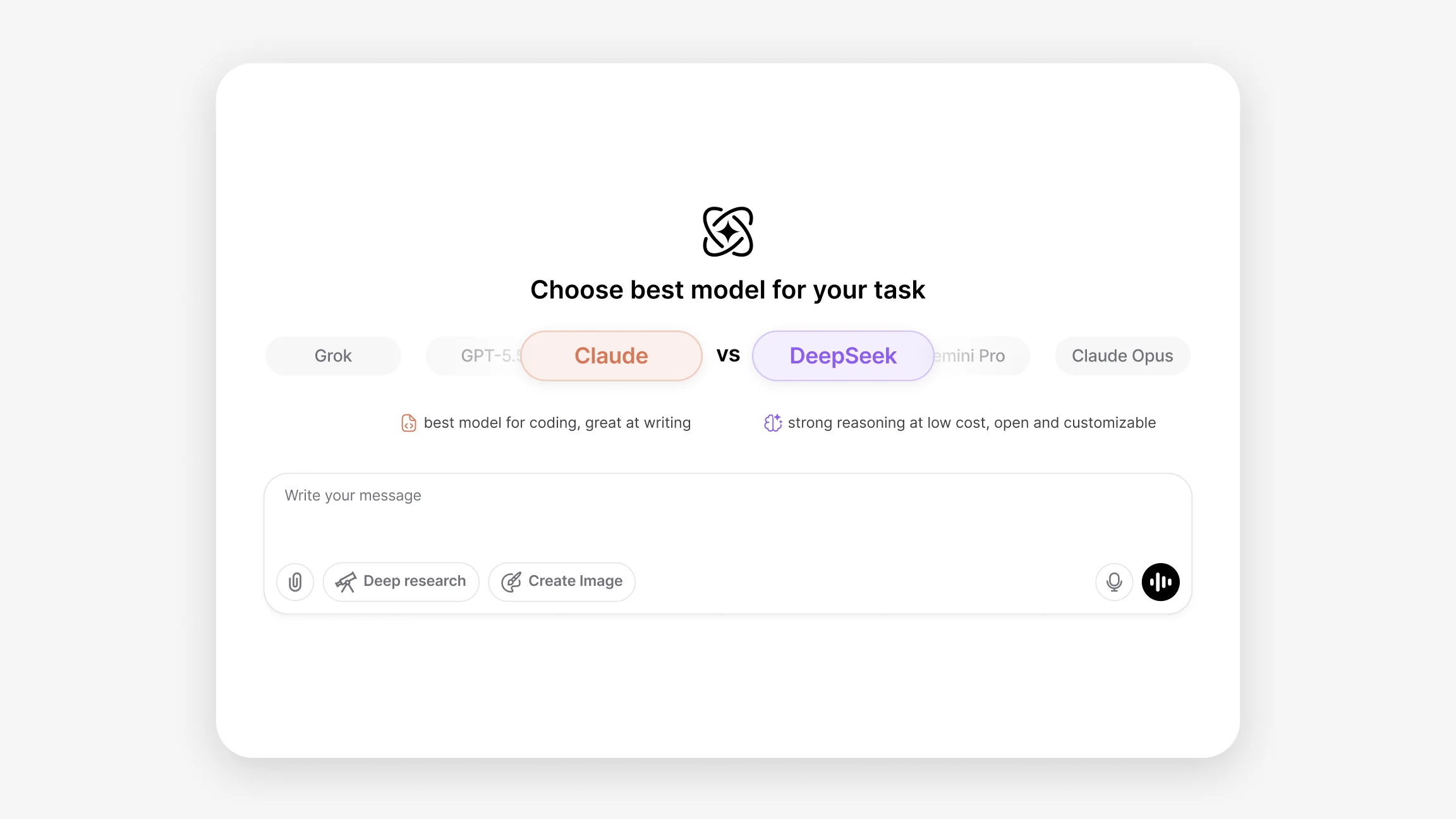
Chat & Ask AI brings both model families into the same interface, so a workflow can move from Claude-based long-form reasoning into DeepSeek-based technical computation without switching platforms. Claude Sonnet 4.6, Claude Opus 4.8, DeepSeek-V4-Pro, and DeepSeek-V4-Pro Thinking are all accessible within the same workspace alongside every other leading AI model. Chat & Ask AI itself handles text, images, documents, and voice within a single session, which means writing, coding, and research tasks stay in one place throughout. Access Claude and DeepSeek together through Chat & Ask AI and compare how each one fits your own workflows.
Claude vs DeepSeek reflects a clear difference in workflow design. Claude fits tasks that need structured long-form reasoning, deep document analysis, and carefully constructed outputs across complex multi-step work. DeepSeek fits tasks that need traceable stepwise computation, technical depth, and reproducible logic across coding and analytical workflows.

 AI Search Engine
 AI Image Generator
 AI Youtube Analyzer
 Whatsapp Integration