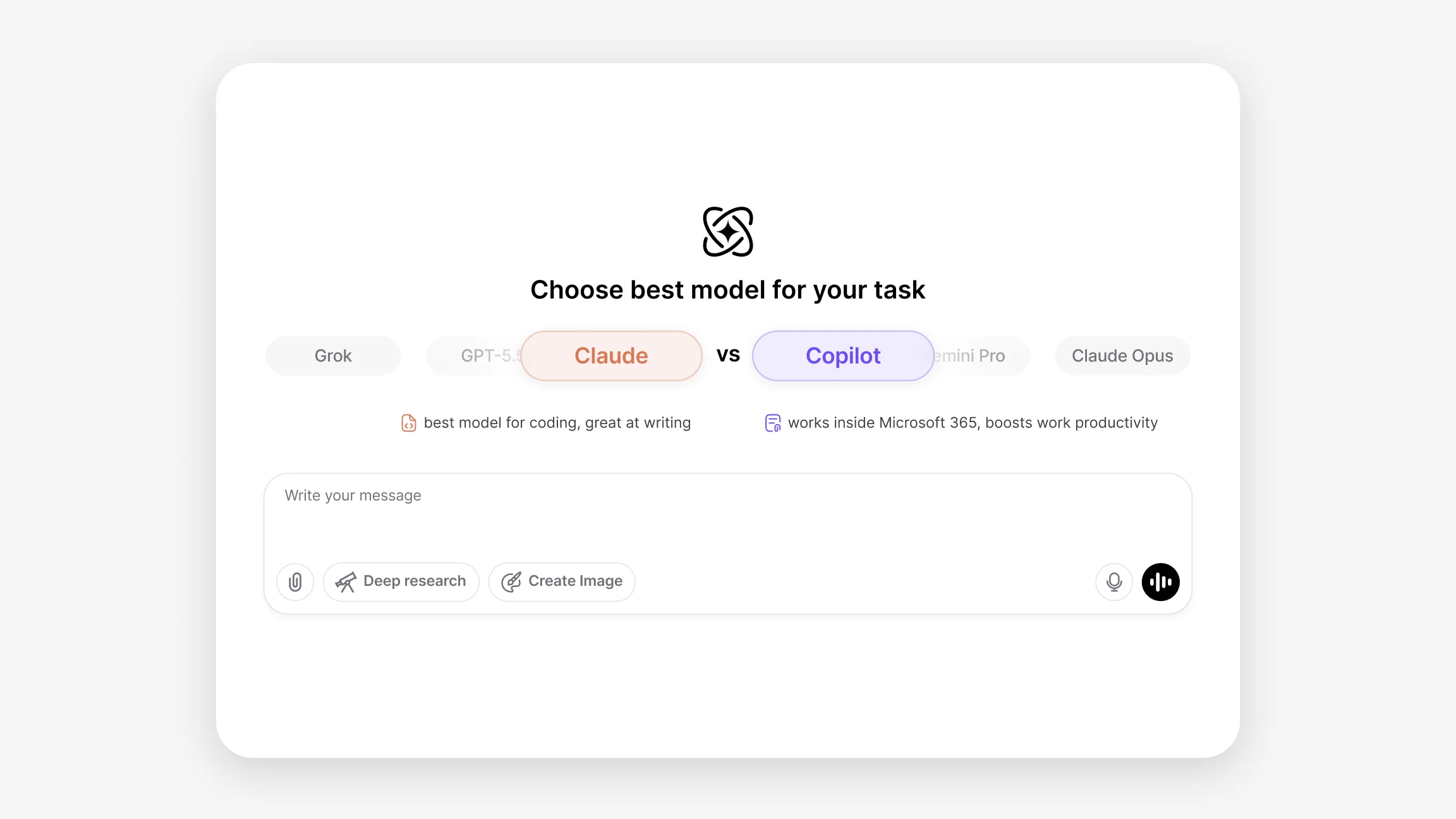
Claude vs Copilot: Feature Comparison for AI Workflows

Claude vs Copilot covers two systems built around different interaction models. Claude focuses on structured long form reasoning, multi step explanations, and deep context handling across writing, debugging, and document analysis. Copilot focuses on inline code completion, editor integrated assistance, and fast, context-aware suggestions within developer toolchains.

Date June 30, 2026 · Emily Harrison

Understanding the Differences Between Claude and Copilot

Claude, built on Anthropic's Claude family including Claude Opus 4.8 and Claude Sonnet 4.6, is designed for extended reasoning tasks and large-context document work. It produces structured, annotated outputs, maintains logical organization across long inputs, and handles complex multi-step debugging and research workflows with clarity and depth. The Claude technology page covers how the Claude 4 series handles chain of thought reasoning, deep context processing, and structured output generation across coding, writing, and analytical workflows.

Copilot, developed by Microsoft, is built for developer-centered workflows inside integrated development environments. It offers inline code completions, function scaffolding, and real time suggestions tied to the current file and cursor context, helping development move faster without leaving the editor. Copilot has no dedicated technology page, so an additional feature link is included below in place of a technology page reference.

Feature area Claude (Claude 4 family) Copilot (M365 / GPT-5)
Primary Focus Structured reasoning, long form explanations, document analysis. Developer centered, inline code completion, IDE assistance.
Response Style Explanatory, step by step, annotated outputs. Concise code suggestions, short comments, direct snippets.
Debugging Multi step debugging explanations, root cause analysis, reproduction steps. Root Cause Focus Quick fix suggestions, code patches, test scaffolding inside editor.
Coding Assistance Generates full functions with structured comments and rationales; supports long horizon agentic coding. Agentic Expert Offers inline completions, context aware suggestions, and autocompletes.
Integration Style API and chat interfaces suited for extended prompts and documents. Deep IDE plugins and editor extensions for live assistance. IDE Native
Large Context Designed for long inputs and document level context. Long Form Leader Optimized for local file and buffer context within the editor.
Reasoning & Plan Strong at multi step reasoning and outlining workflows. Effective at immediate code level reasoning and small tasks.
Writing Support Long form writing, summaries, and documentation generation. Prose Expert Short documentation snippets, function comments, and README fragments.
Productivity Workflows Task breakdowns, meeting notes, and research summaries. Repetitive task automation, boilerplate generation, and quick refactors.
Output Format Structured text, numbered lists, annotated code blocks. Inline code, single file snippets, function completions.
Pair Programming Provides explanations and suggested workflows for collaborators. Acts as a coding partner inside the editor with instant completions.
Testing Support Produces test plans, test case descriptions, and analysis. Generates unit tests and example test code quickly from context. Rapid Scaffolding
Deployment Chat apps, document analysis tools, research assistants. Editor extensions, CI hooks, and code review integrations.
Latency Optimized for conversational interactions and larger tasks. Tuned for low latency inline suggestions during typing. Inline Completion Leader

Coding and Technical Tasks

Copilot is purpose built for live coding assistance. Inline completions, autocomplete for functions, boilerplate scaffolding, and quick refactors all happen within the editor without breaking the development flow. For repetitive coding tasks, CRUD endpoints, serializers, and test scaffolding, Copilot's low latency in context suggestions suit the workflow directly. The AI Chat PDF handles a related use case, working through technical documentation and reference files that inform both research and coding tasks.

Claude handles coding tasks that require architecture-level reasoning, root cause analysis, and long-horizon agentic execution across multiple files. Its step-by-step explanations, annotated code blocks, and structured debugging plans suit tasks where understanding the reasoning behind a solution matters as much as the solution itself. For code review, design documents, and API spec drafts that need extended narrative alongside the code, Claude's explanatory architecture covers ground that inline completion tools are not designed for.

Writing and Content Creation

Claude is the stronger fit for long-form technical writing. Documentation generation, research summaries, and structured explanations with numbered steps and annotated reasoning all benefit from Claude's large-context handling and consistent voice across extended outputs. The AI Writer handles drafting directly within a single interface, working with material gathered from either system.

Copilot contributes to writing tasks that live inside the development workflow, generating short docstrings, inline comments, function-level documentation, and README fragments from the current file context. For writing that goes beyond the immediate codebase into standalone documents or research, Claude's broader context handling is the more direct path.

Research and Web Answers

Claude suits research tasks that require multi-step analysis, in depth document synthesis, and organized summaries with clear internal structure. For research that feeds into a codebase or technical specification, Claude's ability to hold extended context across a session and produce structured outputs makes it a practical fit for the planning phase before implementation begins. The AI Search Engine complements both systems, pulling answers from live web sources when current documentation or technical references are needed alongside document-level analysis.

Copilot handles research tasks that are documentation-adjacent, surfacing quick references, function signatures, and code examples from within the editor context. For research that goes beyond the immediate file or project scope, Claude's broader reasoning capabilities handle more complex queries.

Using Claude and Copilot Through Chat & Ask AI

Chat & Ask AI brings Claude into the same interface alongside every other leading AI model, so workflows that benefit from Claude's long-form reasoning and structured outputs are accessible without switching platforms. Claude Sonnet 4.6 and Claude Opus 4.8 are available within the same workspace, and Chat & Ask AI itself handles text, images, documents, and voice within a single session. Access Claude and other leading models together through Chat & Ask AI and compare how each one fits your own coding, writing, and research workflows.

Claude vs Copilot reflects a clear difference in workflow scope. Claude fits tasks that need structured long-form reasoning, deep document analysis, and carefully annotated outputs across complex multi step work. Copilot fits tasks that need fast inline code assistance, editor integrated suggestions, and real time development support within an active coding session.


FAQ

Frequently Asked Questions

What is the difference between Claude and Copilot?

Claude, built on the Claude 4 family, emphasizes structured reasoning, long form explanations, and document level context. Copilot, powered by GPT-5 models integrated with Microsoft systems, focuses on in editor code completions, inline suggestions, and real time developer workflows.

Is Claude better than Copilot for coding?

The choice depends on the coding task. Claude suits tasks that need extended reasoning, detailed documentation, or long horizon agentic coding. Copilot targets in editor speed and inline code generation. This is a task fit distinction rather than an absolute judgment.

Is Copilot better for fast development workflows?

Copilot is designed for rapid, in context code suggestions inside IDEs and often helps accelerate routine edits and autocompletion during active development.

Which model is better for debugging, Claude or Copilot?

For multi step debugging explanations, reproduction steps, and analysis, Claude is commonly used. For quick code fixes and patch suggestions in the editor, Copilot is often applied.

How do Claude and Copilot compare in reasoning tasks?

Claude tends to produce longer, structured reasoning suitable for planning and documentation. Copilot performs short form reasoning focused on immediate code context and actionable snippets.

Does Copilot work inside IDEs?

Yes. Copilot is commonly integrated into development environments to provide inline code suggestions and context aware completions.

Is Claude suitable for large codebases?

Claude can handle extended inputs and document level context in chat or document workflows, which helps when reasoning across large code artifacts. Copilot typically uses local file and buffer context for targeted suggestions.

How do Claude and Copilot differ in response style?

Claude typically offers explanatory, step by step responses with annotations. Copilot delivers concise, executable code suggestions and quick snippets tailored to the current file context.

Which tool is more useful for daily coding tasks?

For day to day code completion and quick edits inside an IDE, Copilot style assistance aligns with common workflows. For research, debugging documentation, and longer form explanations, a Claude style model is often used.

Can Claude and Copilot be used together?

Yes. Workflows can combine document level reasoning with inline editing assistance by using each system where it fits best, one for analysis and documentation, the other for live coding support.