Writing and Content Creation
ChatGPT is the stronger fit for iterative writing workflows. Organized drafts, style variations, revision cycles, and structured outlines all benefit from GPT-5's multi-turn context retention and consistent instruction-following. For writing tasks that develop across several rounds of editing with tone and formatting maintained throughout, ChatGPT's conversational architecture handles the sustained work reliably. The AI Writer handles drafting directly within a single interface, working with material gathered from either system.
Gemini scales to long form projects and multi-section drafts where the source material is already available. Its large context window allows full documents, reference files, and earlier drafts to stay in scope simultaneously, which suits writing tasks that need to stay consistent across many interconnected sections.
Turning Prompts Into Images
Both ChatGPT and Gemini support image generation from text prompts, but they fit different points in a visual workflow. ChatGPT handles image aware prompts within a structured conversational session, integrating image generation into a broader task flow. Gemini's native multimodal design ties image generation more directly into document and multimedia workflows, handling text, images, and other media together within the same input. The AI Image Generator handles prompt based image generation directly, with output quality in both systems depending on how specific and detailed the prompt is.
Coding and Technical Tasks
ChatGPT handles coding tasks through stepwise explanations, structured debugging walkthroughs, and iterative code editing across a multi-turn session. GPT-5's reasoning architecture keeps earlier context in scope, making it useful for debugging sessions where prior decisions need to stay accessible throughout. The AI Chat PDF handles a related use case, working through technical documentation and reference files that feed into both research and coding workflows.
Gemini handles coding tasks that span large codebases and multiple files. Its large context window suits cross-file reasoning and full codebase review in a single session, while Gemini 3.5 Flash is tuned specifically for fast agentic coding cycles where speed matters alongside context retention.
Research and Web Answers
Gemini integrates live web signals and broader search context more directly into responses, making it well suited to research tasks that need up to date synthesis alongside document analysis. Its large context window allows full reports and document sets to be processed without splitting them, with responses that adapt across task switches. The AI Search Engine extends this further, pulling answers from multiple live web sources when current information is needed alongside document-level analysis.
ChatGPT suits research tasks that benefit from iterative exploration and structured synthesis across a sustained session. For research that develops through follow-up prompts, hypothesis refinement, and organized long-form summaries, ChatGPT's multi-turn architecture builds on earlier context effectively throughout the session.
Using ChatGPT and Gemini Through Chat & Ask AI
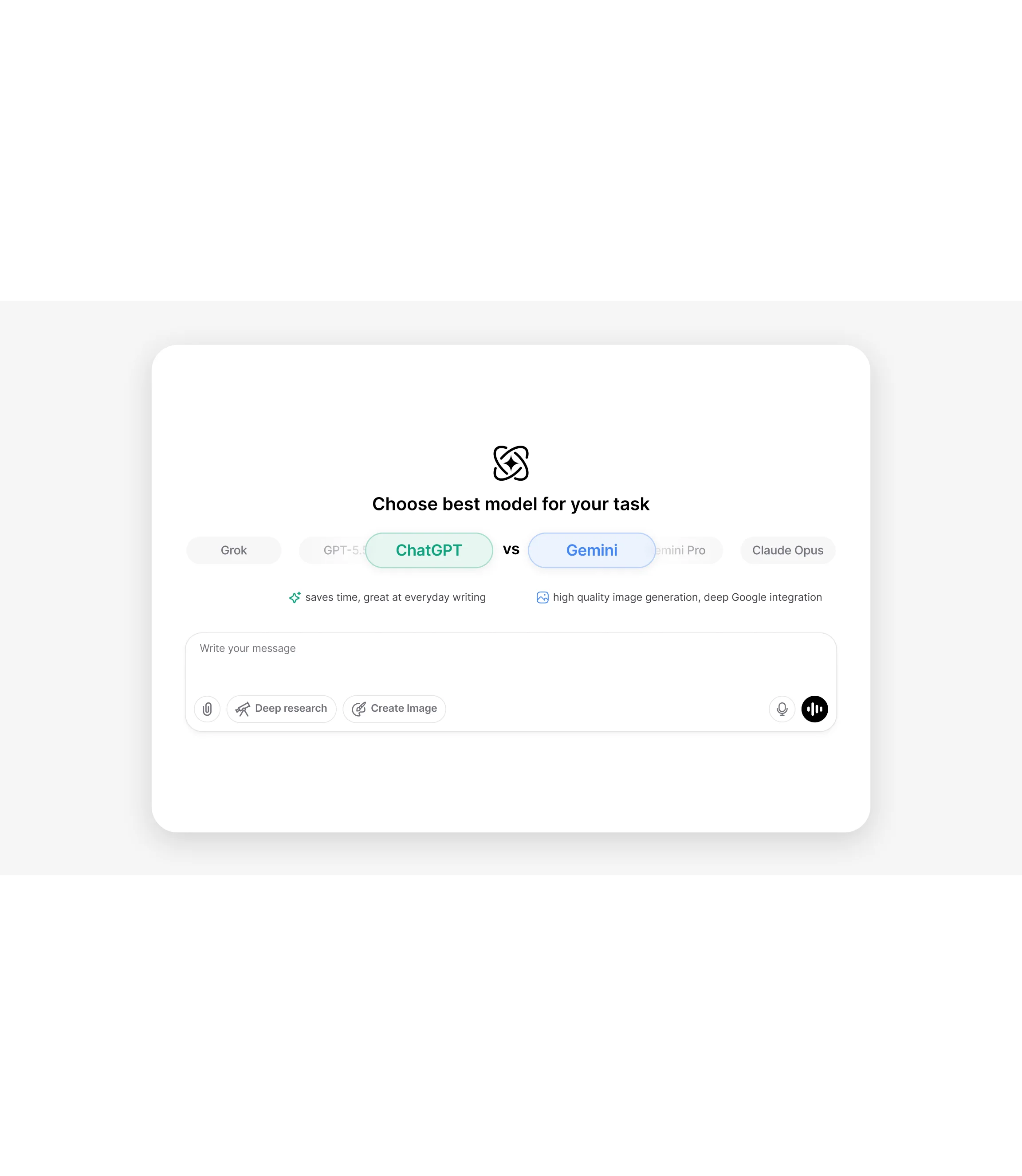
Chat & Ask AI brings both model families into the same interface, so a workflow can move from ChatGPT-based structured reasoning into Gemini-based large-context document analysis without switching platforms. GPT-5.5, GPT-5, Gemini 3.1 Pro, and Gemini 3.5 Flash are all accessible within the same workspace alongside every other leading AI model. Chat & Ask AI itself handles text, images, documents, and voice within a single session, which means writing, coding, and research tasks stay in one place throughout. Access ChatGPT and Gemini together through Chat & Ask AI and compare how each one fits your own workflows.
ChatGPT vs Gemini reflects a difference in workflow design rather than overall capability. ChatGPT fits tasks that need structured multi-turn reasoning, iterative refinement, and consistent outputs across writing, coding, and complex research. Gemini fits tasks that need large context document handling, native multimodal input processing, and adaptive responses across document centered and system connected workflows.

 AI Search Engine
 AI Image Generator
 AI Youtube Analyzer
 Whatsapp Integration