Writing and Content Creation
Claude is the stronger fit for long form writing that requires consistent voice, careful internal coherence, and detailed development across extended documents. Its architecture is built for large-context inputs, which means tone, structure, and earlier decisions stay accessible throughout a long draft without needing to be re-established across separate prompts. The AI Writer handles drafting directly within a single interface, working with material gathered from either system.
ChatGPT fits writing workflows that benefit from iterative refinement across shorter cycles. Structured drafts, style variations, revision passes, and explicit formatting controls all work well within GPT-5's multi-turn instruction-following. For writing tasks that develop through back-and-forth prompting rather than a single sustained session, ChatGPT's conversational architecture handles the iteration efficiently.
Coding and Technical Tasks
ChatGPT handles coding tasks through stepwise explanations, iterative code generation, and structured debugging across a multi-turn session. GPT-5's reasoning architecture and agentic capabilities suit tasks that involve multiple steps chained together, tool use, and iterative refinement where earlier context needs to stay in scope. The AI Chat PDF handles a related use case, working through technical documentation and reference files that feed into both research and coding workflows.
Claude handles coding tasks that require architecture-level reasoning, complex code explanation, and long-horizon agentic execution across large systems. Its large context window suits tasks where multiple files, extended codebases, or long technical specifications need to be held in scope simultaneously without splitting into pieces. For code review and analytical reasoning about system design, Claude's explanatory depth adds precision that shorter-context models may not sustain.
Chatting With PDFs and Long Documents
Claude is purpose-built for deep long-context processing. Full research papers, legal documents, and extended reports can be analyzed in a single session with structured summaries and carefully organized outputs that preserve internal document logic without context breaks. For workflows where a long document needs to be read carefully and analyzed with internal structure preserved, Claude's architecture is designed for this task.
ChatGPT handles long documents effectively through chunking and iterative prompts, producing structured summaries and incremental edits across a session. For documents that fit within a focused session and benefit from back-and-forth refinement, ChatGPT's approach suits the workflow. The AI Search Engine complements both systems, pulling answers from live web sources when current information is needed alongside document-level analysis.
Using ChatGPT and Claude Through Chat & Ask AI
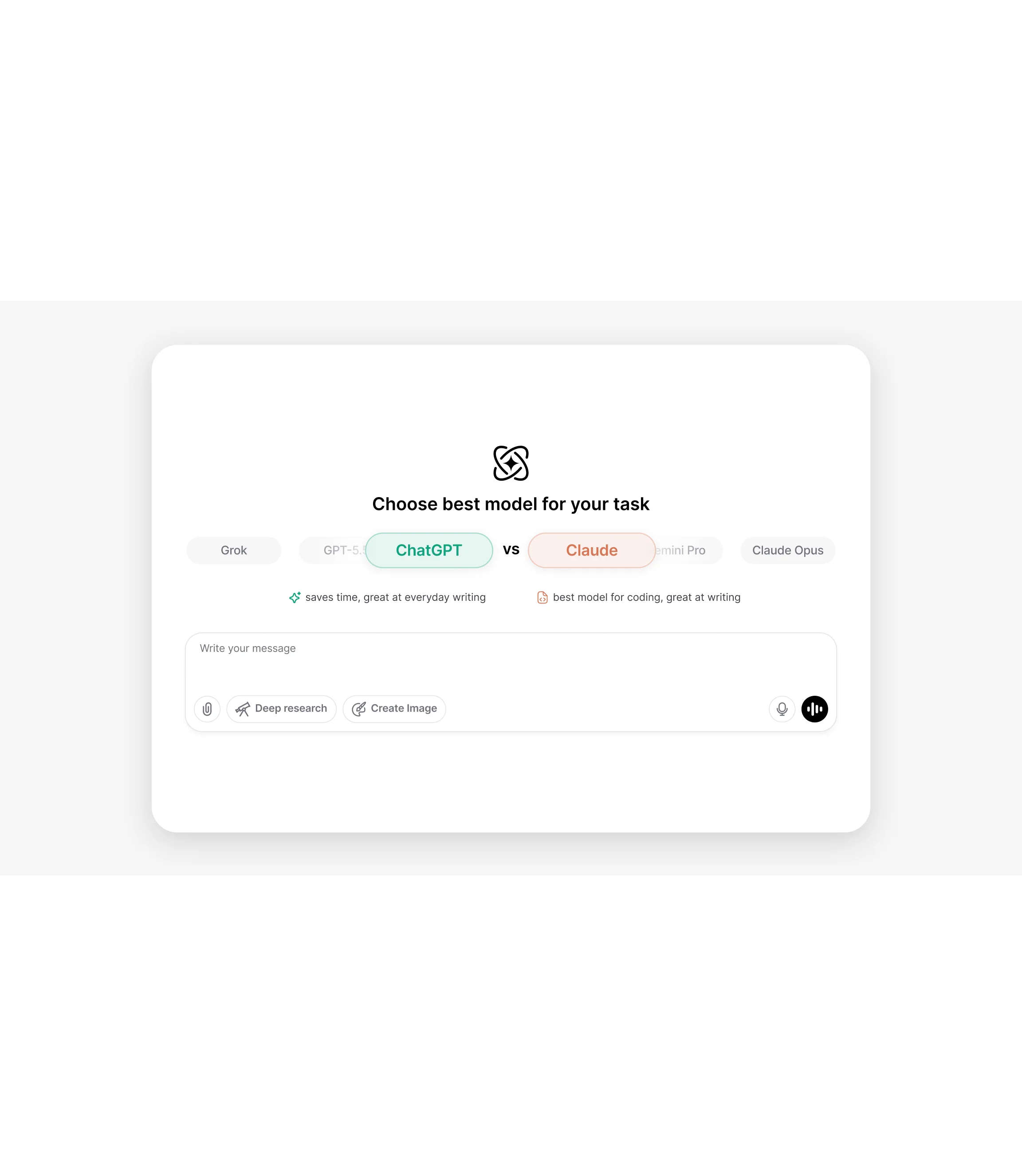
Chat & Ask AI brings both model families into the same interface, so a workflow can move from ChatGPT based iterative task handling into Claude based large context analysis without switching platforms. GPT-5.5, GPT-5, Claude Sonnet 4.6, and Claude Opus 4.8 are all accessible within the same workspace alongside every other leading AI model. Chat & Ask AI itself handles text, images, documents, and voice within a single session, which means writing, coding, and research tasks stay in one place throughout. Access ChatGPT and Claude together through Chat & Ask AI and compare how each one fits your own workflows.
ChatGPT vs Claude reflects a difference in interaction design rather than overall capability. ChatGPT fits tasks that need iterative multi-turn reasoning, explicit formatting control, and structured outputs across writing, coding, and productivity workflows. Claude fits tasks that need sustained large context handling, long form reasoning, and carefully coherent outputs across complex analytical and document-heavy work.

 AI Search Engine
 AI Image Generator
 AI Youtube Analyzer
 Whatsapp Integration