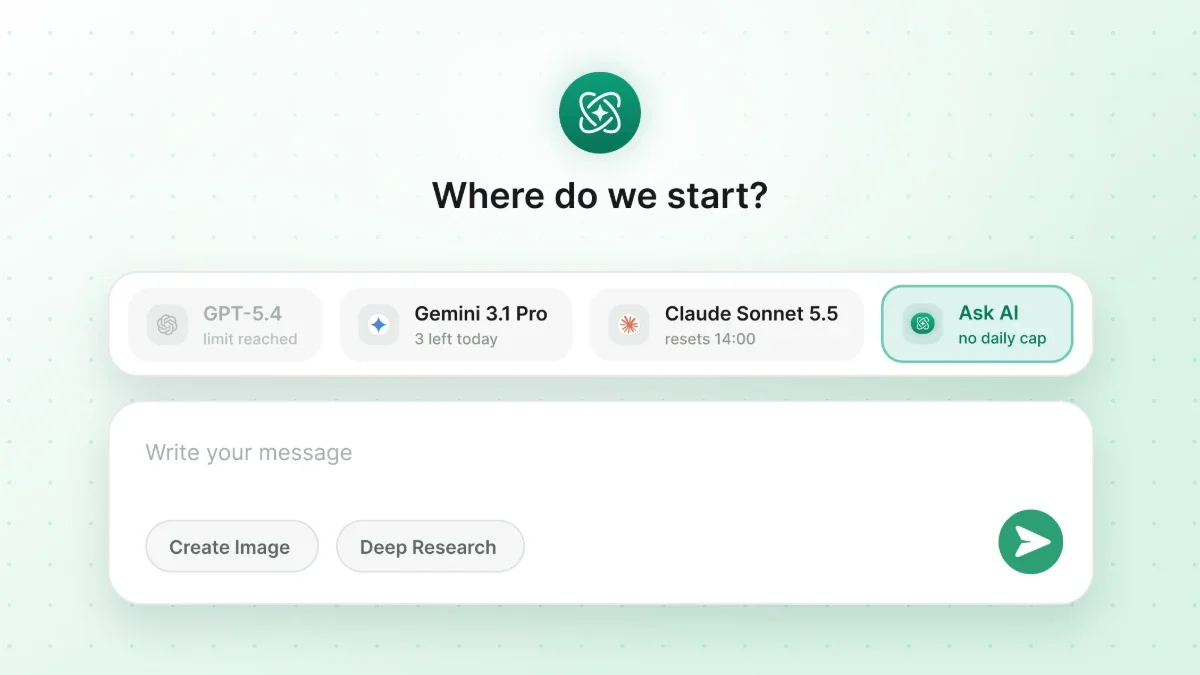

ChatGPT, Claude and Gemini Usage Limits Compared (2026)

ChatGPT, Claude and Gemini all cap how much each plan can be used, but they measure it differently. ChatGPT offers unlimited everyday text chats on its Free and Go plans and meters tools, reasoning and Pro models separately. Claude and Gemini meter compute across a rolling five-hour window and a weekly ceiling. None of the three publishes a fixed message count for most paid plans.

Date October 23, 2026 · Jasmine Bennett

How AI Chatbot Usage Limits Work

An AI usage limit is the amount of work a plan allows within a set time window before access pauses, slows down or switches to a lighter model. The allowance refills on a schedule, so a limit works more like a bucket that refills than a hard monthly quota.

Two measuring systems are in use today. The first counts messages or requests, which is how ChatGPT handles its reasoning models, Pro models and tools. The second counts compute, meaning the processing power each request consumes. Claude and Gemini both use compute-based limits. On those platforms, a single request that reads a 100-page PDF, searches the web and writes code can cost more than dozens of short questions.

Compute-based plans also run on two clocks at once. A short window refreshes every five hours, and a weekly ceiling sits above it. When the short window runs out, access returns after a few hours. When the weekly ceiling runs out, access returns only at the account's weekly reset, even if the five-hour window has refilled.

A usage limit is different from two related terms. A context window is the amount of text a model can hold in a single conversation, measured in tokens. A rate limit usually means the number of API requests per minute allowed for developers. A chat can overflow its context window while the usage meter is nearly empty, and the reverse can also happen.

ChatGPT Usage Limits by Plan

ChatGPT has no single message cap. Each allowance is tied to a specific model, feature or product surface, and each one resets on its own schedule.

Free and Go. OpenAI's Help Center states that Free and Go users have unlimited everyday text chats, subject to abuse-prevention safeguards. This change took effect in August 2026 and replaced the older rolling cap on text messages. File uploads, image generation, voice, data analysis and other tools still have separate limits. On Free, GPT access can also pause until its model limit resets. Upgrading to a paid plan resets Free-tier usage.

Plus. OpenAI does not publish a fixed Plus message number. Limits depend on the selected model, the reasoning level and system conditions. When a manually selected reasoning allowance runs out, ChatGPT may continue with another available model. The limit notice shows the reset time.

Pro. A Pro subscription does not include unlimited use of the Pro models. As of September 2026, OpenAI listed 200 GPT-6 Pro messages per week on the higher Pro tier and a shared pool of 50 messages per week on the entry Pro tier. Reaching a Pro-model cap does not cancel the subscription. It only removes that model until the next reset. More on the model lineup is available on the GPT models page.

ChatGPT Work and Codex use an allowance that is separate from Chat. A long agentic coding task therefore does not reduce ordinary chat capacity. OpenAI Support cannot reset usage manually.

Claude Usage Limits by Plan

Claude measures usage by compute rather than by message count. Every plan has a session limit that resets every five hours, and paid plans add a weekly limit across all models.

Free. The Free plan has a five-hour session limit, and the number of messages varies with demand. Free users can use web search, which counts toward the same allowance.

Pro. Anthropic states that Pro offers at least five times the Free plan's usage per five-hour session. Pro also has a weekly limit that applies across all models. That limit resets at a fixed time assigned to each account.

Max 5x and Max 20x. Max plans provide five or twenty times Pro's usage per session. They keep a weekly limit and add a separate weekly limit for Fable models.

Usage is shared across claude.ai, Claude Desktop and Claude Code. A long coding session in the terminal therefore reduces the allowance available in the browser. Settings > Usage shows progress bars for both the session limit and the weekly limit. On paid plans, usage credits allow work to continue at API rates after a limit is reached.

Anthropic lists the factors that determine how fast the allowance is spent:

  • message length

  • attachment size

  • current conversation length

  • tool usage, such as Research and web search

  • model choice

  • effort level

  • artifact creation

  • multi-step tasks

In September 2026, alongside the release of Opus 5.5, Anthropic raised five-hour limits on its paid plans. The full lineup of Claude models differs in how much of the allowance each one uses.

Gemini Usage Limits by Plan

Gemini uses compute-based limits that refresh every five hours until the account reaches its weekly limit. According to Google's Gemini Apps Help, the calculation considers prompt complexity, the models and features in use, and the length of the chat.

Google publishes multipliers instead of absolute numbers:

  • accounts without an AI plan receive standard limits

  • AI Plus offers twice the standard limit

  • AI Pro offers four times the standard limit

  • AI Ultra offers five or twenty times the AI Pro limit, depending on the subscription

Since October 9, 2026, model access is also tied to the plan. Personal accounts without a subscription can use only Flash-Lite. AI Plus includes Flash-Lite and Flash. AI Pro and AI Ultra include Flash-Lite, Flash and Pro, and Deep Think is available on these two top tiers. Context windows also grow with the plan, from 32K tokens without a plan to 128K on AI Plus and 1M on AI Pro and AI Ultra.

Work and school Google accounts have separate limits and admin controls, so these figures apply to personal accounts only. The Gemini models differ in speed and depth, which affects how quickly each tier's allowance runs out.

ChatGPT vs Claude vs Gemini Usage Limits Side by Side

The table shows how each platform structures its limits as of October 2026.

Feature ChatGPT Claude Gemini
What is measured Messages per model or tool, plus unlimited everyday text Compute per session and per week Compute per window and per week
Short window Varies by model or tool Rolling five hours Five hours
Weekly ceiling On some models and tiers Yes on Pro, Max and Team Yes on all plans
Free tier Unlimited everyday text; tools capped Session limit that varies with demand Standard limits; Flash-Lite only
How plans scale Higher model and tool allowances Pro at least 5x Free; Max 5x or 20x Pro Plus 2x, Pro 4x, Ultra 5x or 20x Pro
Published message counts Only for Pro models No No
Where to check usage Reset time in the limit notice Settings > Usage In-app refresh notice

The main difference is predictability. For plain text conversations, ChatGPT's Free plan is the easiest to understand. Claude and Gemini favor lighter, focused requests, because heavy prompts take more from the same allowance.

What Uses Up an AI Usage Limit Fastest

Long conversations are the most common cause of reaching a limit early. The model rereads the entire thread with every reply, so message 80 in a single chat costs far more than message 2 in a new one. Anthropic notes that conversations long enough to trigger automatic context management use more of the limit.

Heavy features are the next biggest cost. Deep research, web search, code execution, file creation and image or video generation all use much more compute than plain text. Large attachments also add to the cost each time the conversation continues.

Model choice and effort level matter as well. A flagship model or a high reasoning setting gives stronger answers on hard problems but uses up the allowance faster. Choosing the most powerful option for a quick rewrite or a short summary drains capacity without a matching gain in quality.

What to Do After Hitting a Usage Limit

Hitting a limit rarely means the work has to stop. The best option depends on how long the wait is and how urgent the task is.

  1. Check which limit was reached. A ChatGPT notice for image generation does not block text chat, and a Claude session limit is different from the weekly limit. The notice or the usage page shows the exact allowance and its reset time.

  2. Wait for the refresh if it is close. If a five-hour window resets within the hour, waiting is the simplest option.

  3. Switch to a lighter model. Rewrites, outlines and summaries rarely need the strongest model, and lighter models use less of the allowance.

  4. Start a new chat with a summary. Asking for a short summary of the current thread and pasting it into a new conversation lowers the cost of every message that follows.

  5. Use extra capacity where the plan offers it. Claude's paid plans support usage credits, and upgrading ChatGPT from Free resets Free-tier usage.

  6. Move the task to another model. Each provider has its own allowance, so a draft blocked on one platform can continue on another.

Matching Usage Limits to Real Workloads

Students tend to use AI in short bursts before deadlines. This can empty a five-hour window quickly even when weekly use is low. Spreading study sessions across the day and keeping each chat focused on one subject makes the allowance last longer.

Writers and marketers send many short, repetitive requests, such as captions, subject lines and ad variants. Combining related requests into one message is more efficient than sending them separately, and Anthropic recommends this approach in its usage guidance.

Developers face the tightest limits, because coding agents run long, tool-heavy sessions. Several habits help both the session and the weekly allowance last longer:

  • keeping each session to one task

  • clearing old context

  • saving the strongest model for complex debugging

The pattern is the same across all three groups. The type of work matters more than the number of messages, and spreading tasks across more than one model often removes the bottleneck entirely.

Working Across Multiple AI Models With Chat & Ask AI

Each platform's limit applies only to its own models, which is why many users keep more than one AI tool open. Chat & Ask AI brings models from OpenAI, Anthropic and Google together in a single AI chat interface. A task can move from one model to another without changing apps or starting the conversation over.

This setup also makes it easier to match the model to the task. A lighter model can handle quick rewrites and summaries, while a stronger one takes on long documents, analysis or complex reasoning. The same prompt can be sent to different models to compare their answers before choosing one. The full chat history stays in one place, on the web and on mobile.

Try Multiple AI Models Free
FAQ

Frequently Asked Questions

Is ChatGPT unlimited on the free plan?

Everyday text chats on ChatGPT Free are unlimited, subject to abuse-prevention safeguards. File uploads, image generation, voice, data analysis and other tools have separate limits. When one of them is reached, ChatGPT shows the reset time.

How many messages does Claude Pro allow?

Anthropic does not publish a fixed number. Claude Pro offers at least five times the Free plan's usage per five-hour session, plus a weekly limit across all models. The actual count depends on message length, attachments, conversation length, model and tools.

How often do Claude usage limits reset?

The session limit resets every five hours on every Claude plan. Pro, Max and Team plans also have a weekly limit, which resets at a fixed time assigned to the account and is shown in Settings > Usage.

What are Gemini's usage limits on the free plan?

Free Gemini accounts get standard, compute-based limits that refresh every five hours, up to a weekly limit. Since October 9, 2026, personal accounts without a Google AI plan can use only the Flash-Lite model in the Gemini app.

Which AI chatbot has the highest usage limits?

It depends on the type of work. ChatGPT offers unlimited everyday text on Free and Go, while Claude Max 20x and Gemini AI Ultra provide the largest compute allowances. Heavy use of tools and reasoning reduces the real capacity of every plan.

Does starting a new chat reset the usage limit?

No. Limits apply to the whole account, not to individual chats. A new chat costs less per message because the model rereads less history, but it does not refill the allowance.

What is the difference between a usage limit and a context window?

A usage limit controls how much a plan can be used over time. A context window controls how much text the model can hold in one conversation. Either one can be reached without the other.

Can Chat & Ask AI be used when ChatGPT, Claude or Gemini limits run out?

Chat & Ask AI is a separate service from ChatGPT, Claude and Gemini subscriptions, so their plan limits do not apply to it. It provides access to models from OpenAI, Anthropic and Google in one interface, so work can continue on a different model in the same place.

Chat & Ask AI

AI CHAT, WRITING & PRODUCTIVITY PLATFORM

Chat & Ask AI is an AI platform that brings conversational chat, writing assistance, document analysis, and image generation into one subscription. You can access several leading AI models depending on the task, ask questions, draft content, review a PDF, or generate a visual within the same conversation. To experience how a multi-model workspace can streamline your unified daily workflow, you can create your workspace account today without adding extra tools to your routine, or learn more about Chat & Ask AI.

96% of users report increased efficiency and faster workflows after switching to Chat & Ask AI.