Best AI Roleplay Chat Apps in 2026: 8 Picks for Every Story

The best AI roleplay chat apps in 2026 split into clear camps. Chracter AI offers the largest character library, Talkie leads on mobile and voice, Kindroid suits one long-term companion, NovelAI is built for long-form fiction, and SillyTavern and Backyard AI give full control over models and memory. Perchance covers quick free sessions, while general-purpose models such as Claude and Grok deliver the strongest writing. The right pick depends on three things: how well an app remembers the story, how strict its content rules are, and how good the underlying model writes.

DateJuly 10, 2026 · Daniel Brooks

Best AI Roleplay Chat Apps at a Glance

Quick picks:

  • Best character library: Character AI

  • Best for mobile and voice roleplay: Talkie

  • Best for one long-term character: Kindroid

  • Best for long-form fiction: NovelAI

  • Best for full control: SillyTavern

  • Best for private, offline roleplay: Backyard AI

  • Best for quick free sessions: Perchance AI Chat

  • Best writing quality: general-purpose models such as Claude and Grok

App Best for Memory tools Content policy Platforms
Character AI Browsing ready-made characters Pinned messages, persona settings Strict filters Web, iOS, Android
Talkie Voice and visual roleplay Character memory, cards Moderate filters iOS, Android, web
Kindroid One deeply customized companion Long-term memory, journal entries User-set limits iOS, Android, web
NovelAI Novels and worldbuilding Lorebook, memory field Writer controlled Web
SillyTavern Custom setups with any model Lorebooks, character cards Depends on the model Self-hosted
Backyard AI Private roleplay on a computer Character cards, lore Depends on the model Desktop, local
Perchance AI Chat Instant sessions without setup Basic memory Light moderation Web
Claude, Grok and other general models High-quality narrative writing Projects, long context Provider policies Web and apps

How These Apps Were Chosen

Each app was assessed on four criteria that decide whether a roleplay session holds together after the first evening:

  • Memory: how many details a character keeps once a story runs to hundreds of messages;

  • Writing quality: whether replies stay in voice, move the plot forward and avoid repetition;

  • Customization: how much control exists over personas, world rules and scenes;

  • Reliability: clear content rules, stable access and transparent data practices.

Platforms built mainly around explicit adult content were left out on purpose. The list focuses on creative storytelling, adventure, practice conversations and character-driven fiction.

The 8 Best AI Roleplay Chat Apps in 2026

1. Character AI: Best Character Library

Character AI remains the default starting point for AI roleplay. Its community has created millions of characters, from fantasy heroes and historical figures to tutors and interview coaches, so almost any premise already exists as a ready-made bot. Group chats allow several characters in the same scene, and new characters take only minutes to create.
The trade-offs come from scale. Filters are the strictest of any app here, which can interrupt darker fantasy or combat scenes, and characters can lose track of plot details in long sessions. The platform also restricted open-ended chat for users under 18, a change that shaped how many families and schools view it.
Best suited to: newcomers who want to start a story in seconds without writing a character from scratch.

2. Talkie: Best for Mobile and Voice Roleplay

Talkie is built for the phone. Characters speak their replies aloud with distinct voices, and illustrated character cards add a collectible, visual layer to each story. Short, scene-based roleplay feels natural in the app, especially during commutes or breaks.
Long, complex narratives are harder to sustain, and content moderation has tightened over time. As a lighter, more immersive option on mobile, it has few equals.
Best suited to: players who prefer listening and quick scenes over long written chapters.

3. Kindroid: Best for One Long-Term Character

Kindroid takes the opposite approach to Character.AI. Instead of a large catalog, it focuses on a single, deeply customized character with a backstory, personality traits and long-term memory that can be edited directly. Voice calls and generated images add realism to the relationship.
This depth works best for ongoing stories with one main character rather than sprawling casts. Users who switch characters often will find the setup slower than catalog apps.
Best suited to: writers who want one character to remember months of shared history.

4. NovelAI: Best for Long-Form Fiction

NovelAI treats roleplay as co-writing. Its Lorebook stores characters, places and rules, and entries are recalled automatically whenever they become relevant, which keeps large fictional worlds consistent. The writing tools allow fine control over style, pacing and how much the AI contributes.
It is less of a chat app and more of a writing studio, so quick back-and-forth conversation feels less natural. Access works on a subscription basis after a short trial.
Best suited to: novelists and worldbuilders who care about prose and continuity.

5. SillyTavern: Best for Full Control

SillyTavern is an open-source interface rather than a service. It connects to commercial APIs or to locally hosted open models like Llama, then layers character cards, lorebooks, group chats and detailed prompt controls on top. Almost every aspect of a roleplay session can be adjusted.
That freedom requires setup. Installing it, choosing a model and tuning settings takes time, and quality depends entirely on the model connected. For experienced roleplayers, no other option offers the same flexibility.
Best suited to: technical users who want to choose the model and shape every rule.

6. Backyard AI: Best for Private Roleplay

Backyard AI runs language models directly on a computer, so stories never leave the device. It supports character cards and lore, and it requires no technical scripting to get started. Privacy-minded users get a simpler path to local roleplay than with SillyTavern.
Performance depends on the hardware. A modern graphics card handles larger models smoothly, while older laptops are limited to smaller models with weaker writing.
Best suited to: users who want offline storytelling with no cloud account.

7. Perchance AI Chat: Best for Quick Free Sessions

Perchance AI Chat opens in a browser and starts a story immediately, with no account required. Characters can be described in a few lines, and the interface stays simple enough for a five-minute adventure or a quick test of a new idea.
Memory and writing quality are basic compared with the other apps, so long campaigns lose consistency quickly. As a free sandbox, it does its job well.
Best suited to: casual players who want to try AI roleplay before committing to an app.

8. General Purpose Models: Best Writing Quality

Large general-purpose models often write better roleplay than dedicated apps, because their reasoning and long context keep plots coherent. Claude is known for nuanced characters and careful, literary prose, which suits mystery, drama and slow-burn stories. Grok brings a quicker, more playful tone that fits comedy, banter and fast adventure scenes.
These models do not come with character libraries, so the setup happens in the prompt. A short character brief, covered below, closes most of that gap.
Best suited to: writers who value prose quality and are happy to define characters themselves.

Companion-Style Apps Worth Knowing

Alongside the eight picks above, several apps focus on a single, ongoing AI companion rather than on story-driven roleplay. They suit people who want continuity with one character over time more than a library of personas.

  • Nomi: built around long term memory and companion-style continuity, aiming to keep earlier conversation details consistent over extended use.

  • Replika: centered on one ongoing AI companion with a customizable avatar rather than a rotating cast of characters.

  • Anima: a companion-style app built around personalized, everyday conversation.

  • Paradot: customizable AI companions with an emphasis on casual, everyday interaction.

  • Talefy: a narrative-driven app that builds the whole experience around interactive storytelling.

These apps work best as conversation partners and story companions. As with any companion-style AI, they remain tools for creativity and practice, not a replacement for real relationships.

Common Uses for AI Roleplay Chat

  • Storytelling and character development: testing a character's voice, motivations and reactions before writing a scene.

  • Language learning: practicing everyday dialogues, such as ordering food or checking into a hotel, in a target language.

  • Social and interview practice: rehearsing a job interview, a negotiation or a difficult conversation in a low-stakes setting.

  • Creative brainstorming: exploring an idea from a character's perspective to find angles that a plain prompt would miss.

  • Entertainment: interactive adventures, mysteries and games played one message at a time.

Best AI Chat for Roleplay by Story Style

The best AI chat for roleplay changes with the kind of story being told.

  • Fantasy and RPG campaigns: NovelAI's Lorebook or SillyTavern's world info handle large casts, maps and magic systems. Dice rolls and character stats can be added to the opening rules.

  • Mystery and horror: Claude and other strong reasoning models keep clues consistent and build tension without revealing the twist too early.

  • Science fiction: models with long context track technology rules, ship names and timelines across long arcs.

  • Slice of life and comfort stories: Kindroid and Talkie suit gentle, ongoing conversations with familiar characters.

  • Practice scenarios: interview rehearsals, language practice and difficult conversations work well on any general model, since the goal is realism rather than worldbuilding.


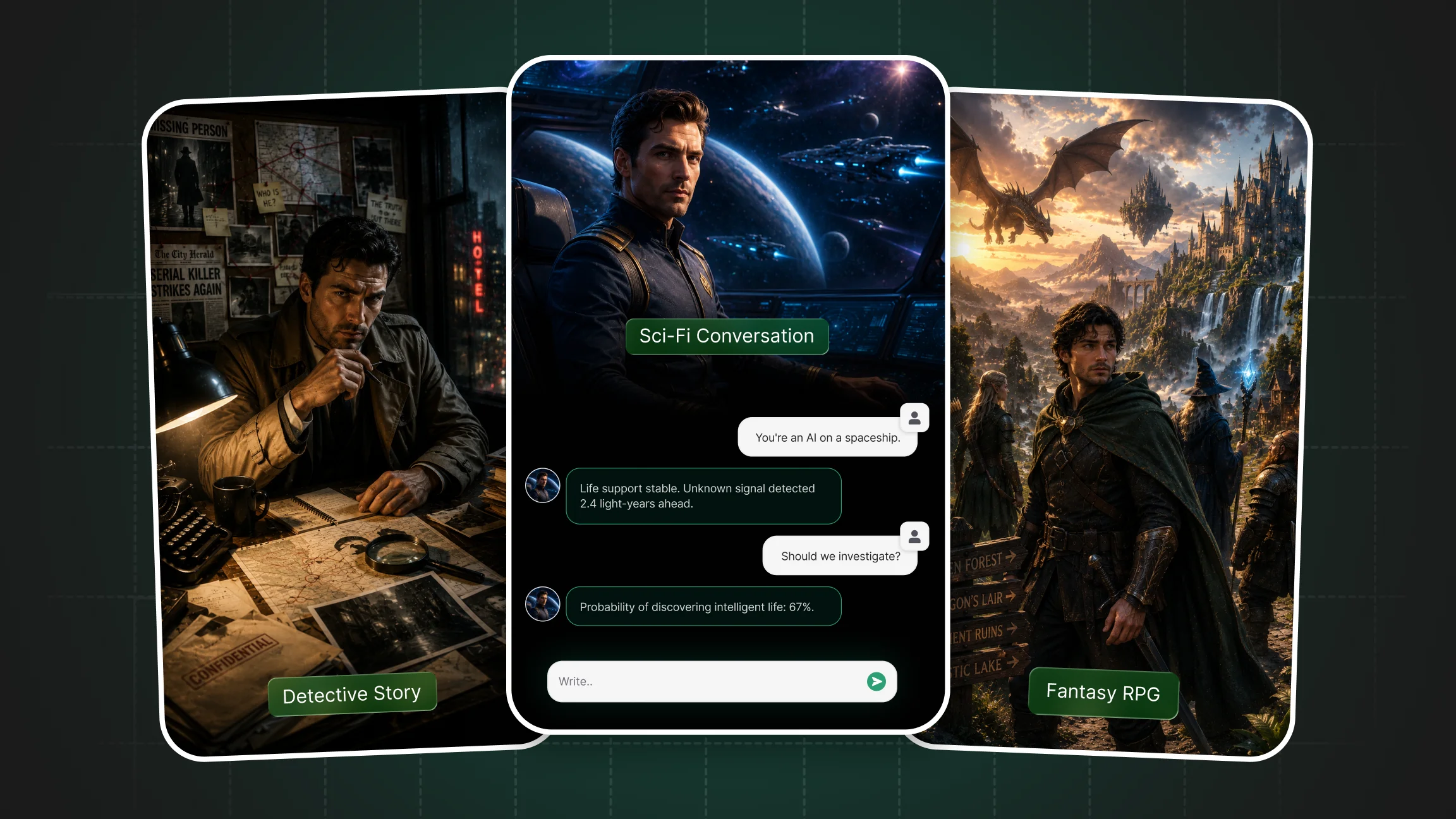
🚀 Sci-Fi

AI SPACE MODE
You're an AI on a spaceship.
🤖 AI Assistant: Life support stable. Unknown signal detected 2.4 light-years ahead.

🔍 Detective

NOIR MODE
Act as a detective in 1920s London.
🕵️‍♂️ Detective AI: A handwritten letter waits on the desk. The ink is still fresh.

🔮 Fantasy

RPG GAME MASTER
You are the captain of a skyship.
🧙‍♂️ Game Master: The clouds part, revealing floating ruins glowing with blue crystals.

💻 Cyberpunk

NETRUNNER MODE
Bypass the mainframe firewall.
⚡ Net-AI V3: Access granted. Nodes decrypted. Main data core fully exposed.

Keeping Characters Consistent in Long Roleplay

Every AI model has a context limit, so long stories eventually push early details out of view. The fixes below solve the most common problems.
The character's personality drifts. The original description has scrolled out of context. Re-pasting a short character brief every few dozen messages restores the voice.
Names, places or relationships change. Key facts were mentioned once and never repeated. A lorebook entry, pinned message or recap keeps them active.
Replies start repeating. The model is echoing its own recent patterns. Asking for a new scene, a time skip or a different point of view breaks the loop.
The AI writes the user's actions. The rules never limited the AI to its own character. One line in the opening rules fixes this: "Write only for [character name]; never describe the user's actions."
A character brief that works with any app or model:

  • Name, age and role in the story;

  • Three personality traits and one flaw;

  • Speech style, with one sample line of dialogue;

  • Goal in the current scene;

  • Relationship to the user's character;

  • Rules: point of view, reply length, topics to avoid.

A scene reset that recovers a story that has gone off track: "Pause the story. Summarize what has happened so far in five bullet points, then continue from the moment [character] enters the library, keeping the tone tense and quiet."

Writing a Strong Roleplay Opening Prompt

The first message sets everything that follows. A strong opening defines the setting in two or three sentences, names both characters, sets the tone and states who controls which character. It also gives the AI a concrete situation to react to rather than an open question.
A weak start reads: "Let's do a fantasy roleplay." A stronger version reads: "A rain-soaked harbor town at night. I play Mira, a smuggler with a stolen map. Play Captain Hale, a tired harbor master who suspects her. Keep replies under 150 words, stay in character and end each reply with a choice for Mira." The second prompt gives the model a place, a conflict and a rhythm, so the story starts moving immediately.
Opening scenes borrow many techniques from fiction. A list of creative writing prompts offers ready-made premises that convert easily into roleplay setups.

Safety, Privacy and Age Ratings

Roleplay apps differ sharply in how they handle safety. Character.AI and Talkie run strict or moderate filters and have introduced age-based restrictions, while self-hosted tools such as SillyTavern and Backyard AI leave content decisions to the user and the chosen model. Checking each app's age rating and content policy before sharing it with a younger reader is essential.
Privacy follows a similar split. Cloud apps store conversations on their servers, often to improve their models, while local tools keep everything on the device. Personal details, real names of friends and sensitive information are best kept out of any roleplay story.
Healthy use matters too. Companion-style characters can feel personal, but they remain AI models. Treating roleplay as storytelling and practice rather than a replacement for real relationships keeps the experience positive.

Roleplay With Several AI Models in Chat & Ask AI

Different stories call for different storytellers, and switching between separate roleplay apps means rebuilding characters each time. Chat & Ask AI keeps leading models in one app, so the same character brief can run on Claude for a slow-burn mystery, on Grok for a fast comedy scene, or on another model for a sci-fi campaign, all without new accounts.
The same workspace generates visuals for the story. Character portraits, maps and scene illustrations can be created with Nano Banana and added beside the chat, turning a text adventure into an illustrated one.

Start a story free
FAQ

Frequently Asked Questions

What is the best AI chat for roleplay?

Character AI is the easiest starting point thanks to its character library. NovelAI suits long-form fiction, SillyTavern offers the most control, and general-purpose models such as Claude produce the strongest writing.

What is the best free AI roleplay app?

Character AI and Perchance AI Chat are the most generous free options. Perchance works without an account, while Character AI offers far more ready-made characters.

Which AI roleplay app has the best memory?

Kindroid and NovelAI lead on memory. Kindroid keeps long-term memories for one character, while NovelAI's Lorebook recalls world details whenever they become relevant.

What does AI chat RP mean?

RP stands for roleplay. AI chat RP means writing an interactive story in which an AI plays one or more characters while the user plays another.

How to make an AI stay in character?

A clear character brief, an opening rule that limits the AI to its own character, and regular recaps keep personalities consistent across long sessions.

Can AI roleplay apps be used offline?

Yes. Backyard AI and SillyTavern with a locally hosted model run entirely on a computer, so stories stay private and work without an internet connection.

Are AI roleplay apps safe for teenagers?

Safety depends on the app. Some apps restrict users under 18, and content policies vary widely, so checking the age rating and filters of each app is the first step.

Can AI roleplay help with language practice?

Yes. Roleplaying everyday scenes, such as ordering food or a job interview, gives realistic conversation practice in a target language with instant feedback.

What are the best Character AI alternatives?

Popular Character AI alternatives include Talkie for voice roleplay, Kindroid and Nomi for long-term companions, NovelAI for long-form fiction and SillyTavern for full control over models and memory.

Can Chat & Ask AI be used for roleplay?

Yes. Chat & Ask AI runs character-driven stories on several leading models, and the same character brief can move between models to match each story's tone.

Can Chat & Ask AI create images for a roleplay story?

Yes. Chat & Ask AI generates character portraits, maps and scene illustrations from text prompts in the same app used for the story.

Chat & Ask AI

AI CHAT, WRITING & PRODUCTIVITY PLATFORM

Chat & Ask AI is an AI platform that brings conversational chat, writing assistance, document analysis, and image generation into one subscription. You can access several leading AI models depending on the task, ask questions, draft content, review a PDF, or generate a visual within the same conversation. To experience how a multi-model workspace can streamline your unified daily workflow, you can create your workspace account today without adding extra tools to your routine, or learn more about Chat & Ask AI.

96% of users report increased efficiency and faster workflows after switching to Chat & Ask AI.