Read together, these patterns explain the impression most people describe. AI text often reads as polished but impersonal, technically fine yet oddly frictionless. Human text reads as less even and more grounded, with the roughness usually coming from the writer knowing something specific enough to disturb the flow.
Why Does AI Writing Often Sound Repetitive?
Repetition is a direct consequence of how the text is generated. A language model selects likely continuations, and the most likely continuation is by definition the least surprising one, so phrasing regresses toward an average across the whole piece.
You see this most clearly in three places. Transitions repeat because a handful of connective phrases are far more probable than the alternatives. Section openings repeat because the model settles into a template that worked once and keeps returning to it. Lists become symmetrical because once the first item establishes a grammatical shape, matching that shape is the highest-probability move for every item after it.
The effect compounds with length. A short answer rarely shows it, while a long article gives the pattern enough room to become obvious. This is also why writers who use AI heavily start recognizing their own tool's habits after a few weeks.
What Are AI Writing Checkers and How Do They Work?
An AI writing checker analyzes a text and estimates the probability that it was produced by a language model. The word estimates carries real weight here, since these tools return a likelihood score rather than a determination.
They work by analyzing statistical patterns rather than meaning. Two measures do most of the work. The first is how predictable each word is given the words before it, since machine-generated text tends to choose higher-probability continuations more consistently than a person does. The second is how much sentence structure and length vary across the passage, since human writing fluctuates more. Neither measure looks at whether the content is true, original or good.
Originality checking is a different operation and worth separating clearly. An AI Plagiarism Checker compares a text against existing published sources to find overlapping material, which answers whether the words appeared somewhere before. A detection tool analyzes the text's own internal pattern, which answers whether the words look machine-produced. A text can pass one and fail the other in either direction, which is why editorial and academic workflows commonly run both.
Are AI Detectors Reliable?
Detection results are probabilistic and should never be treated as proof of authorship. They are useful as one input among several, and unreliable as a verdict on their own.
Several specific limitations shape how much weight a result deserves. Human-written text is sometimes flagged, and this happens disproportionately to writing that is structurally regular, which includes technical documentation, translated material and work by non-native speakers. AI-written text sometimes passes, particularly after light editing. Short samples produce unstable results, since the statistical measures need enough text to mean anything. Mixed and edited content is the hardest case of all, because a passage that was drafted by a model and then substantially rewritten by a person is genuinely both.
Accuracy also varies by tool and by content type. A result on a personal essay and a result on a lab report are not comparable, even from the same checker on the same day.
The practical takeaway is about how you use the number. A detection result is a supporting signal that should prompt a conversation, not a finding that settles one. If a score prompts you to ask a writer about their process and they can walk you through it, the score has done its job.
What Should You Do if Your Own Writing Is Flagged as AI?
Being flagged is not the same as being caught, and the response is to demonstrate authorship rather than to argue with the score.
Keep your drafts and version history. A document with a visible edit trail, false starts and abandoned paragraphs is far more informative than any detector output, and most writing tools preserve this automatically. Be ready to explain your sources and your process, including where a particular argument came from and what you rejected along the way.
Add the concrete detail only you could know. Specific figures from your own work, named examples, and the particular case that made you change your mind are all things a model cannot fabricate about your situation. Vary your structure where the meaning calls for it, rather than mechanically, since deliberate irregularity that serves no purpose reads as strangely as uniformity.
Finally, ask what other evidence the result is being combined with. A responsible process treats detection output as one item in a file, alongside drafts, prior work and a direct conversation.
Can AI Replace Human Writing?
AI cannot fully replace human writing, and the reasons are practical rather than philosophical.
It shortens drafting and structuring substantially, which is real value and covers a meaningful share of the hours writing consumes. What it does not cover is originality that comes from having done something, judgment about what a specific reader needs from this specific piece, and accountability for what gets published under a name.
That last point does most of the work. Someone has to be answerable for whether a claim is true, whether the framing is fair and whether the piece serves the person reading it. A model has no position from which to take that responsibility, which keeps a person in the process regardless of how good the drafting gets.
How Do Writers Combine AI and Human Input?
The working pattern that has settled in practice divides the task by where each side adds most. AI handles research summaries, structural options and first drafts. The writer sets the angle, supplies the specifics, controls the tone and verifies every factual claim before it ships.
A typical sequence runs like this. You start with the argument you want to make, since that is the part you cannot delegate. You ask for three possible structures and pick the one closest to the shape in your head. You draft with an AI Writer to get material on the page, then rewrite the sections where your own knowledge is the point. You check every number, name and date against the source. You read it aloud and cut whatever sounds like it came from a template.
The strongest results come from applying AI at the stages where the writer adds least, which is usually structuring and first-pass drafting. Applying it at the stages where the writer adds most produces exactly the flat, unspecific text this article has been describing.
Analyzing and Refining Your Writing with Chat & Ask AI
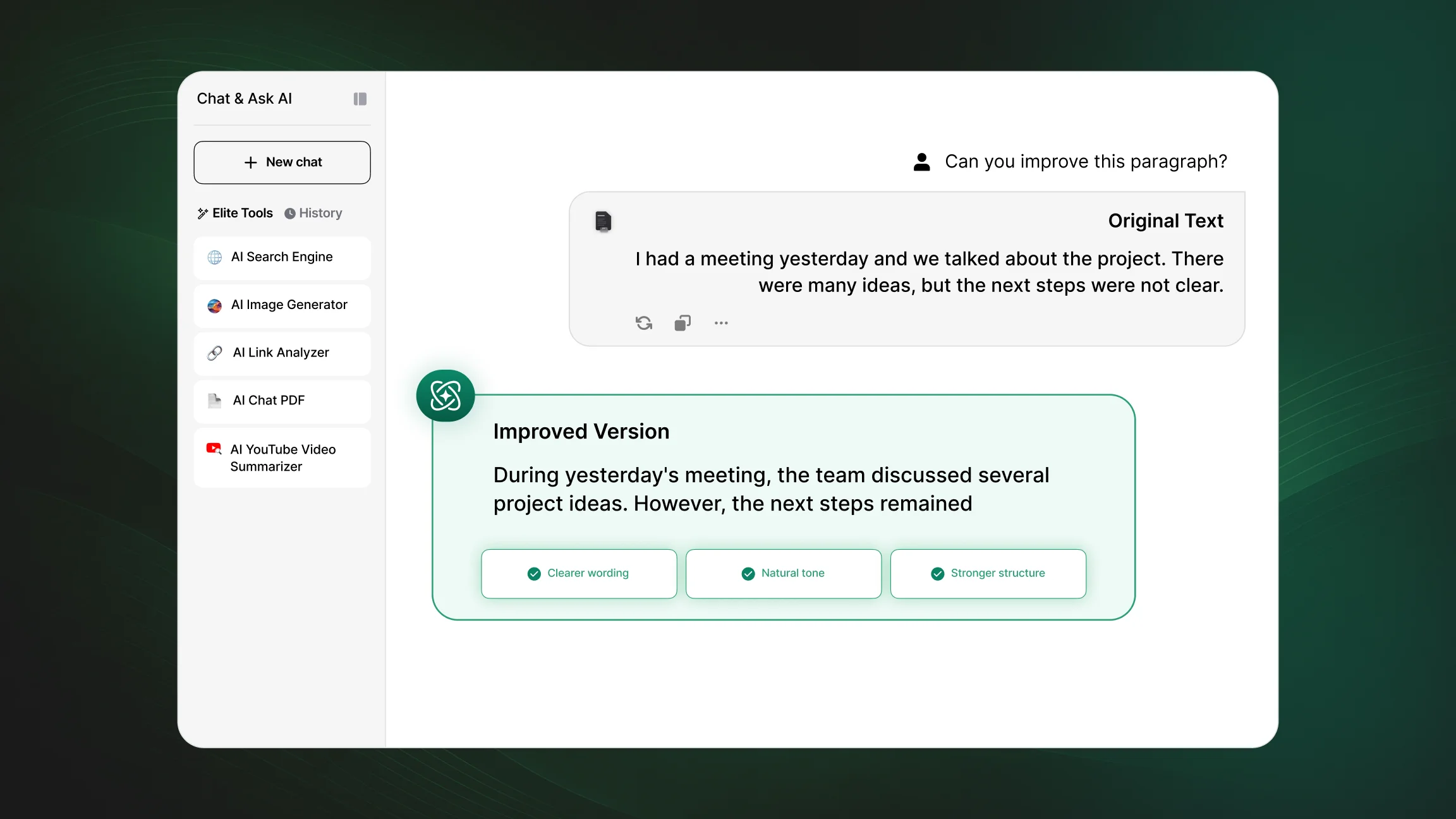
Chat & Ask AI keeps drafting, reviewing, analyzing and originality checking in one place, which matters because these steps feed each other. You can draft a piece, examine it for the patterns described earlier in this article, revise the sections that show them, and check the result without moving between separate tools or re-pasting text.
The model behind the conversation can be changed depending on what the current stage needs. Available families include GPT-5 developed by OpenAI, Claude developed by Anthropic, Gemini developed by Google, Llama developed by Meta, and DeepSeek. For writing specifically, switching matters because models differ in how closely they follow structural instruction and how they handle long source documents, so the model that produces a usable outline is not always the one you want reviewing a finished draft.
The AI Detector covers the analysis stage. It examines a text for the statistical patterns discussed above and reports which sections contributed to the result. As with any tool of this kind, the output is indicative rather than definitive, and it is most useful when you read it alongside the text itself rather than in isolation.
Used together, these steps turn a vague instinct that something reads as automated into a specific edit. You see which paragraphs are uniform, which examples are generic, and which transitions repeat, and you fix those rather than rewriting the whole piece and hoping.
Both the signals and the tools give you information, and neither gives you a conclusion. A person still decides what a flat paragraph or a high score actually means for a particular piece of writing. Keeping the writing, the review and the check in one place, as Chat & Ask AI does, makes that judgment easier to exercise while the text is still in front of you.

 AI Search Engine
 AI Image Generator
 AI Youtube Analyzer
 Whatsapp Integration